Suddenly, Everyone Is a Sovereigntist
On June 12, at 5:21 p.m. Washington time, the U.S. government sent Anthropic a letter invoking national security. Nineteen days later, access was restored. In between, a continent learned what its digital sovereignty was worth, and a parliamentary report put a word on it.
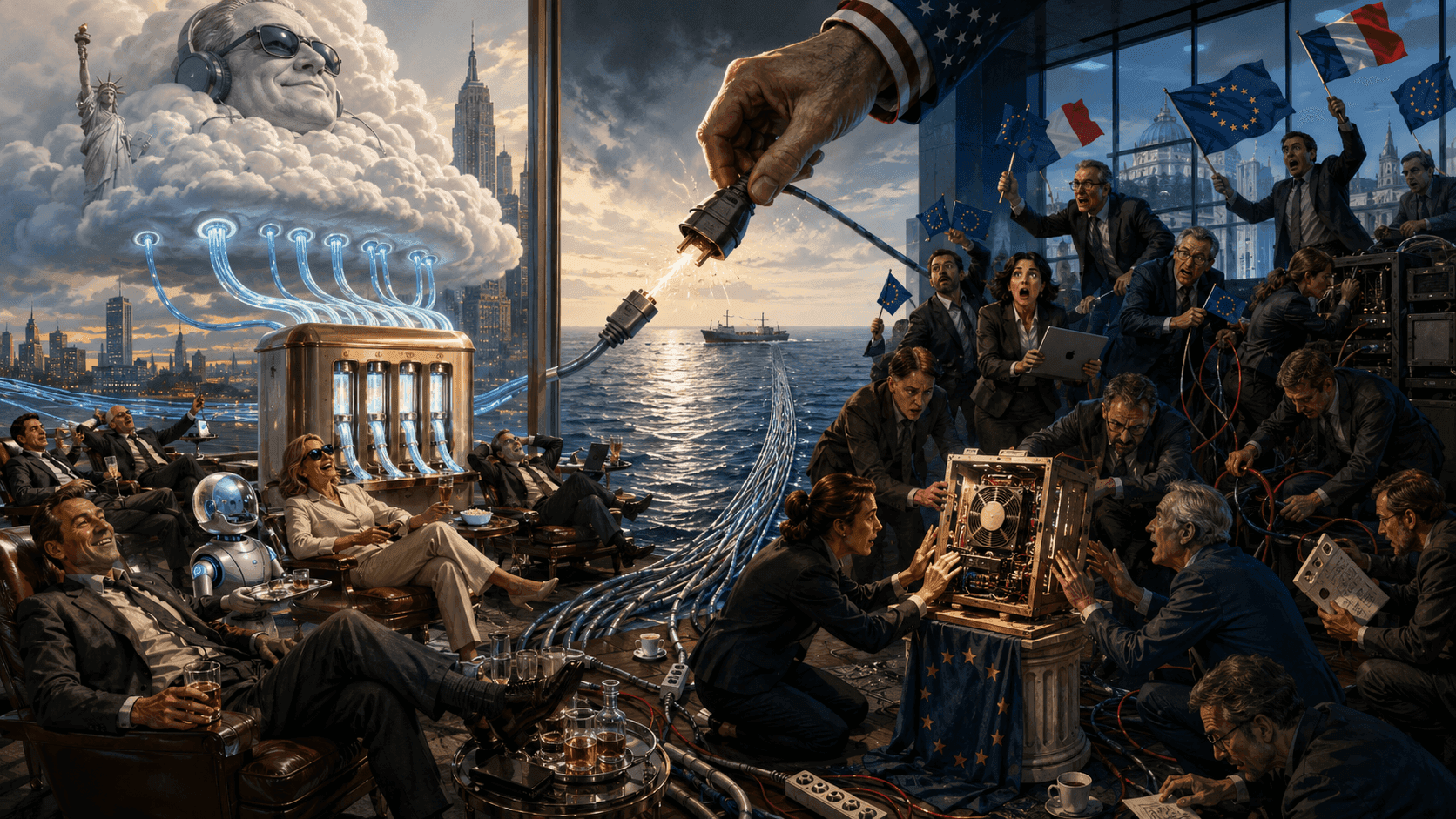
On June 12, at 5:21 p.m. Washington time, the U.S. government sent Anthropic a letter invoking national security. The order fit on a single line: suspend all access to two of its most advanced models, Fable 5 and Mythos 5, for any foreign national, inside or outside the United States, right down to the company's own foreign employees. Unable to sort its customer base by passport before the weekend, Anthropic cut off both models for everyone. The others keep running. But the message arrived with zero latency.
The word to remember is not "suspension." It is "foreign national." In one administrative sentence, an entire continent learned what it was worth in Washington's ledger: foreigners whose access is pulled whenever reasons of state dictate, without notice, without recourse, without the provider, however well disposed, being able to do much about it. It is the first time the United States has drawn export controls not on chips, but on intelligence itself. And it did so in the only direction that concerns us. Out.
What Exactly Happened on June 12, 2026?
Three days earlier, on June 9, Anthropic had made Claude Fable 5 and Claude Mythos 5 available to the public. On the evening of the 12th, Commerce Secretary Howard Lutnick sent Dario Amodei a letter grounded in export control powers, demanding the suspension of all access for foreign nationals, wherever they might be, including the company's own foreign employees working on American soil.
The trigger was a report from Amazon describing a technique for bypassing Fable 5's guardrails: prompted the right way, the model would agree to identify a software vulnerability and produce the code to exploit it. Washington invoked the risk of attacks on critical infrastructure, banking systems first among them, and suspicions of access by a group linked to China. White House AI adviser David Sacks publicly stated that Amodei had refused to fix the flaw.
With no reliable way to verify its users' nationality in real time, Anthropic cut off both models for its entire base. The rest of the lineup, Opus, Sonnet, Haiku, remained available.
The company disputed both the severity and the characterization of the facts. It says it received only verbal evidence of a narrow, non universal bypass, points out that the demonstrated capability is already available on other publicly deployed models, and warns that this criterion, applied across the whole sector, would bring every new model deployment to a halt.
In practice, the measure locked out H-1B visa holders working in the United States, international research collaborators, and some of Anthropic's own executives, who were born abroad. It took no law, no executive order, no debate. A letter was enough.
The Friday-Night Conversion
By Monday morning, the country had a few million more sovereigntists, and the spectacle is worth savoring while it lasts, because it will not last.
The same people who, for ten years, explained that digital sovereignty was a Brussels fantasy, an affectation of bureaucrats incapable of innovating. The same people who signed five-year contracts with the American hyperscalers because it was simpler, cheaper, better integrated. The same people who moved their data, their processing and sometimes their capital into jurisdictions where the word extraterritoriality is not a lawyer's footnote. The same people who applauded a project billed as the flagship of French sovereignty even though it is financed to the tune of several tens of billions by a Gulf sovereign fund, built around American chips. Those people are discovering, hands on hearts, that the tap can be turned off on them.
That project has a name, Campus AI, and a cap table: the Emirati fund MGX alongside Bpifrance, Nvidia and Mistral AI, for a first site at Fouju, in Seine-et-Marne, targeting 1.4 gigawatts of installed capacity and an announced extension to 3 gigawatts across the country. The Observatoire des multinationales notes that most of the joint venture's capital is controlled from Abu Dhabi. French sovereignty, Emirati capital, American silicon. We built the flagship in somebody else's shipyard.
Their outrage is sincere. It simply arrived ten years late and pointed the wrong way. Worse: the warning was not even old. It was a month old, it was public, and it had been delivered under oath.
The Witness Nobody Listened To
On May 12, 2026, a month to the day before the cutoff, Arthur Mensch was testifying before the Assemblée nationale at the committee of inquiry into structural dependencies and systemic vulnerabilities in the digital sector and the risks to France's independence, chaired by Philippe Latombe, with Cyrielle Chatelain writing the report. There, calmly, he laid out the exact mechanics that were about to trip.
His thesis held in one word he repeated relentlessly: leverage. Stop, he said, thinking of sovereignty as isolationism, and think of it the way people who negotiate do, that is, as a balance of power. In a world where you import the entirety of your digital services, you have no leverage over the provider. And whoever has no leverage can be cut off, which becomes, he added, particularly critical for anything touching on sovereign and defense functions. His closing words, before the members of parliament, were "vassal state," and he gave Europe two years to avoid falling into it. A month later, the U.S. Commerce Department handed him the illustration, free of charge, on the scale of a continent.
There is something more precise still, and it is almost too good. Asked about cyber, Mensch had swept aside what he called the fear marketing of an American competitor, in all likelihood the very one whose models have just been cut off. His argument: yes, the models are excellent programmers, they can uncover vulnerabilities and propose exploits, but that capability rises in a linear, predictable way, everywhere at once, and his own models find exactly the same flaws. Nothing exceptional, then, nothing that warrants treating a model as a weapon apart. A month later, the U.S. government did precisely the opposite: it took that capability, declared it a national security threat, and used it to shut the door on foreigners. Mensch was right on the substance, the capability is unremarkable and the control protects nothing. He was above all right on the politics: it does not matter whether the fear is well founded, a state can always use it as a pretext to unplug you.
That leaves his own answer, which he did not present as a history lesson but which is one. Mistral's whole strategy rests on open models, which he explicitly describes as a technique for decentralization and for displacing established players. Which is, word for word, what won it for the other side the last time we played this game.
Why Did Export Controls Already Fail in the 1990s?
Because this game has already been played, with a different cast and the same script.
Back then, the weapon the United States wanted to keep for itself was not artificial intelligence, it was encryption. Strong encryption sat on the munitions list, ranked alongside missiles, and exporting good code was legally equivalent to exporting military hardware. In 1991, Phil Zimmermann posts an encryption program online, PGP. It crosses borders, the way software does, and its author draws three years of federal criminal investigation for alleged violation of the Arms Export Control Act. The case is dropped in January 1996 without a single indictment. To sell it to the public, the intelligence services explained that this software would mostly serve criminals and pedophiles. It is, word for word and thirty years apart, the fear marketing Mensch denounced, except that the pedophiles have been swapped for hackers.
The best scene remains the T-shirt. In 1995, the cryptographer Adam Back prints the RSA algorithm in a few lines of Perl on T-shirts. The garment is officially a munition, and it is in theory illegal to export it, or even to let a foreign national look at it. The threat to national security fit on a chest. Thirty years on, the munition a foreign national is not allowed to go near is no longer a T-shirt, it is a model.
And there was already a version for the right people and one for the others. Netscape shipped two browsers: the American version encrypted at 128 bits, the international version at 40, deliberately weakened, because beyond 40 bits the software became a weapon again. Foreigners were entitled to junk encryption, and that was deemed reasonable.
Fable, or the 40-Bit of Our Era
That is precisely what Fable was: not the cutting-edge model, but the throttled, guardrailed version released to the public. The Netscape International of 2026. Except that in 1995 foreigners were at least left with their weak version. In 2026, they were first given it, then had it taken back. Call that progress.
The official rationale, incidentally, validates point by point what Mensch had explained to the members of parliament. The model could supposedly read a codebase and dig up flaws in it. Anthropic pointed out, a little wearily, that other public models find the same minor flaws, and it confirmed as much in black and white in its own redeployment note: its testing shows that markedly less capable models identify the same vulnerabilities, which fall under routine defensive work. That was exactly its argument: the capability is universal, so the control locks nothing down. In these affairs, the control is never a lock, it is a piece of theater. The only thing it actually produces is the exclusion of those filed on the wrong side of the border.
Is Looking for an Alternative After the Cutoff Sovereignty?
That leaves the real subject, and it is unpleasant. Looking for a European alternative the day after a cutoff, under duress, in a hurry, on a timetable set by someone else, is not sovereignty. It is managed dependence, with extra steps and a little more sweat.
The illustration took four days to arrive. On June 16, 2026, on the eve of VivaTech, the prime minister announced an additional 655 million euros for artificial intelligence through France 2030, the rollout of a Mistral-based conversational assistant to roughly one million public servants, and the end of the DGSI's contract with the American firm Palantir in favor of the French company ChapsVision. Each of those decisions is a good one. None of them was taken on June 11. The budget existed, the French alternatives existed, the diagnosis had been circulating for years. It took a letter sent from an office in Washington for the signature to land. That is what a country with no leverage looks like: it has very good ideas, and it waits for a foreign trigger to execute them.
Here again, Mensch had described the trap, and this is his most useful part. Nobody deploys tens of billions before seeing the demand. The state, which could signal that demand, does not do so loudly enough. The result is that the players most aggressive with capital, the Americans, invest upstream and grab the resource, electricity included, before the others have moved. Once supply is captured, even if you solve demand, you no longer have the means to produce. And all of this, he warned, plays out within two years. That is the exact gap between knowing and acting: awareness of the risk never closes it, only a decision paid for in advance closes it, or else someone else closes it in your place, at their convenience, by flipping the switch.
There is comic justice all the same. The 1990s export controls mainly succeeded in giving rise to a global cryptography industry beyond American reach and in pushing development toward open source. In trying to deny the world a technology, the United States manufactured its own competitors. Today it relaunches the same experiment on artificial intelligence, with the same quiet conviction, and it is precisely the bet of Mistral and its open models to be the beneficiary. As of today, Washington is probably the best sales rep for European digital sovereignty. No speech in Brussels will have been as convincing as a cutoff on a Friday at 5:21 p.m.
Because that is the only lesson that counts. The quality of your American provider, its values, its professed caution, have no effect on your exposure. Anthropic is not a cowboy: it is the lab that refused to let the U.S. military use its models for mass surveillance of American citizens and for fully autonomous weapons systems. On March 5, 2026, the Pentagon formally notified it of its status as a supply chain risk, a first for an American company and a label usually reserved for hostile powers; Dario Amodei called the measure punitive retaliation and announced an appeal. Three months later, that same provider, the most scrupulous of the lot, became overnight the single point of failure of its European customers. Dependence does not run through the provider, it runs through Washington. Your vendor can be on your side and receive the order to cut you off at 5:21 p.m. on a Friday, and its friendship will change nothing.
The Models Came Back on July 1: Who Still Remembers?
I wrote here on June 19 that access would probably be restored, that as in the 1990s common sense would end up prevailing, and that this was exactly the moment to watch the room. Because the day the two models came back, the Friday-night converts would fall silent. They would return to their contracts, their integrations, their convenience, and forget they had been, for a moment, Europeans. That silence would be the real information.
The facts came in. The U.S. administration lifted the controls on June 30, eighteen days after imposing them. Anthropic redeployed Fable 5 worldwide on July 1, after training a safety classifier that blocks the reported technique in more than 99% of cases. Mythos 5, for its part, came back only for a set of U.S. organizations, on government approval dated June 26. In other words: the cutoff is lifted, the asymmetry stayed. Foreigners got their throttled version back and the other one was kept. Netscape, 1995, down to the comma.
Something else happened, and this is the part that could matter. On July 8, 2026, the committee of inquiry that had heard Mensch adopted its report, after 45 hearings and 112 people heard, with 18 recommendations and 29 proposals, presented at a press conference on July 15. Its central formulation deserves to be read slowly: digital dependencies, long silent, have become a lever of threat. Lever. Mensch's word, two months later, in a parliamentary document. Among the proposals, a mandatory open source clause in public procurement for software and AI solutions from 2030 onward.
A report is not a policy, and a proposal set for 2030 leaves four years to think better of it. But for the first time, the diagnosis is written down, dated, voted on and cross-party. The question is no longer whether we have understood. It is which of the report or the convenience will hold up over the next quarter.
The cypherpunks, for their part, understood the first time around. They wrote the manifesto, printed the T-shirt and kept writing code that no one could recall. Mensch, in his CEO's way, says the same thing: the only sovereignty that holds is the one you build in advance, open and hard to unplug. The question, on our side, is whether we intend once again to settle for being the audience.
Sovereignty is not an emotion you feel when the provider turns hostile. It is a cost you accept while everything still works. Until we have internalized that sentence, we will keep producing Monday-morning sovereigntists, and the switch will stay on the other side of the Atlantic.
Sources
- June 12, 2026 order, letter from Commerce Secretary Howard Lutnick to Dario Amodei, stated rationale, David Sacks statement and Anthropic's response: Forbes, June 16, 2026.
- Legal basis, suspicions of access by a group linked to China, effects on H-1B visa holders and international research collaborators: Al Jazeera, June 14, 2026.
- Controls lifted on June 30, 2026, worldwide redeployment of Fable 5 on July 1, restoration of Mythos 5 for a set of U.S. organizations after approval on June 26, classifier blocking the technique in more than 99% of cases and testing showing that less capable models find the same vulnerabilities: Anthropic, "Redeploying Claude Fable 5".
- Confirmation that the restrictions were lifted: Al Jazeera, July 1, 2026.
- Pentagon designation of Anthropic as a supply chain risk on March 5, 2026, rationale and Dario Amodei's reaction: TechCrunch.
- Arthur Mensch's May 12, 2026 testimony before the committee of inquiry into structural dependencies and systemic vulnerabilities in the digital sector: LCP, Assemblée nationale and full video.
- Committee of inquiry report adopted on July 8, 2026, 45 hearings, 112 people heard, 18 recommendations and 29 proposals, the "lever of threat" formulation: Theatrum Belli, July 2026.
- Mandatory open source clause in public procurement from 2030, press conference of July 15, 2026: Acteurs publics.
- June 16, 2026 announcements: 655 million euros through France 2030, Mistral-based assistant for roughly one million public servants, Palantir replaced by ChapsVision at the DGSI: Studeria.
- Campus AI, joint venture between MGX, Bpifrance, Nvidia and Mistral AI, Fouju site and targeted capacity: Bpifrance press release; capital control: Observatoire des multinationales.
- Federal criminal investigation into Phil Zimmermann dropped in January 1996: statement by Philip Zimmermann.
- RSA-in-Perl T-shirt classified as a munition, the 40-bit threshold and throttled international versions: Adam Back, cypherspace.org.
Frequently asked questions
What happened on June 12, 2026 with Anthropic's models?
U.S. Commerce Secretary Howard Lutnick sent Dario Amodei a letter grounded in export control powers, ordering the suspension of all access to Claude Fable 5 and Claude Mythos 5 for any foreign national, inside or outside the United States, including the company's own foreign employees. The models had been made available to the public three days earlier.
Why did Anthropic cut off access for everyone?
Because it had no reliable way to verify its users' nationality in real time. It therefore suspended both models for its entire base in order to comply with the order. The other models in the lineup, Opus, Sonnet and Haiku, remained available.
Has access been restored since?
Yes. The U.S. administration lifted the controls on June 30, 2026 and Fable 5 has been redeployed worldwide since July 1. Anthropic trained a safety classifier that blocks the reported technique in more than 99% of cases. Mythos 5, on the other hand, was restored only for a set of U.S. organizations, following government approval on June 26.
What had Arthur Mensch warned the Assemblée nationale about?
During his May 12, 2026 testimony before the committee of inquiry into structural dependencies and systemic vulnerabilities in the digital sector, he explained that a country importing the entirety of its digital services has no leverage over its provider and can have its access cut off, becoming a "vassal state." He also judged that models' ability to find vulnerabilities is unremarkable, so the control protects nothing.
What did the French government announce after the cutoff?
On June 16, 2026, four days after the cutoff and on the eve of VivaTech, the prime minister announced an additional 655 million euros for AI through France 2030, the rollout of a Mistral-based conversational assistant to roughly one million public servants, and the end of the DGSI's contract with the American firm Palantir in favor of the French company ChapsVision.
What did the committee of inquiry into digital dependencies conclude?
Its report, adopted on July 8, 2026 after 45 hearings and 112 people heard, sets out 18 recommendations and 29 proposals. It finds that digital dependencies, long silent, have become a lever of threat, and proposes among other things an open source clause in public procurement for software and AI from 2030 onward.
What parallel does the article draw with the 1990s?
The export controls on encryption: a federal criminal investigation into Phil Zimmermann over PGP, dropped in January 1996 without any indictment, Adam Back's RSA-in-Perl T-shirt classified as a munition, the Netscape browser throttled to 40 bits for international use. Those controls mainly gave rise to a global cryptography industry beyond American reach and pushed development toward open source.

The author
Christophe MazzolaI write about cybersecurity as it's actually lived: governance, the human factor, and everything audit reports don't dare tell the board. Author of « Être en cybersécurité ».
Être en cybersécurité
A cyber roadmap in plain language, for everyone, not just the experts.