The century turns on technology. Our politicians invent a tax by the gigabyte.
The Socialist program's tax on data flows is not just a bad idea. It is the confession of a political class that, faced with the technological shift of the century, found nothing better than its oldest reflex: look for what is not yet taxed, and tax it.
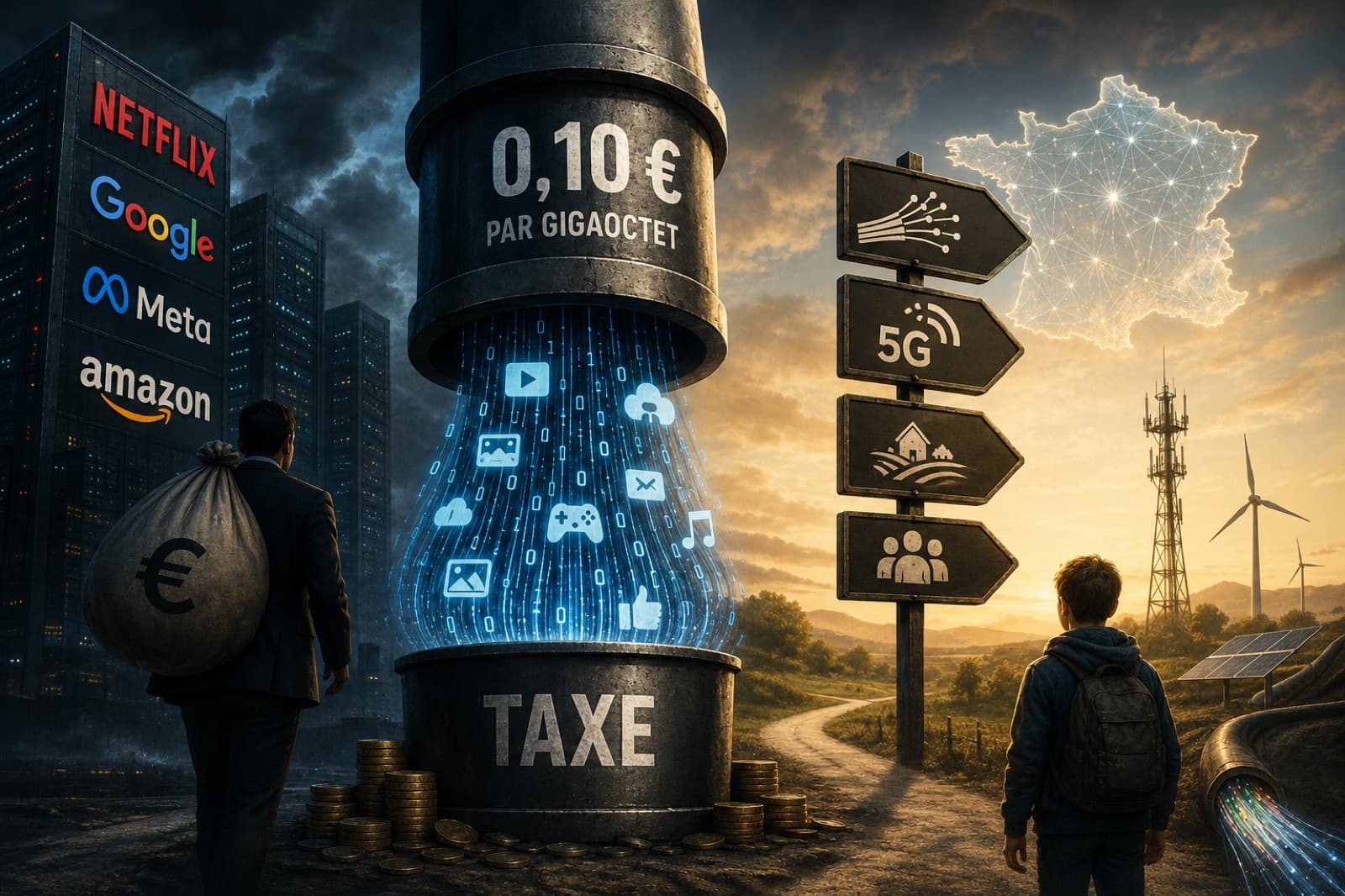
For decades, a large part of French political debate has revolved around the same reflex. A spending line appears, a hole opens, a promise demands funding, and the answer always comes from the same end: find a base. A product, a flow, a transaction, something that still escaped tax and that can finally be tapped. We have taxed tobacco, sugar, plane tickets, streaming. The Socialist Party has just added a line to the list in its program for 2027: a tax on digital data flows, ten cents per gigabyte.
Who would pay the gigabyte tax, the user or the tech giants?
Concretely, the idea is as follows. Every piece of data that travels over French networks, a film, a series, a web page, a game update, represents a volume measured in gigabytes. This volume would be taxed at ten cents a unit, and the money raised would fund the infrastructure, fibre and 5G, that the big platforms use massively without paying for it. Many thought it was a tax on their subscription and pulled out the calculator: two hundred gigabytes a month, twenty euros more on the bill. That is not the plan. The tax would target peering, that is, the flows that Netflix, Google, Meta or Amazon pour into the operators' pipes, close to half the traffic entering France according to Arcep. It is these giants that would pay, not the internet user. The target is clear, and it even looks legitimate: those who saturate the networks should help build them.
The figure is anything but anecdotal. In its 2025 report, Arcep measures incoming traffic of 56 Tbit/s, up 10.4% year on year, of which 49% is concentrated on just five actors: Akamai, Netflix, Amazon, Google and Meta. Netflix leads, on its own 12.3% of everything entering French networks. On paper, making this handful of companies contribute to maintaining the pipes they fill looks like common sense.
You do not put a meter on a river
And yet, the idea is bad. Even limited to a handful of American giants, it does not hold, for a simple reason: you do not put a meter on a river. A data flow has no border of its own. The same content can arrive from a server on the other side of the world, from a cache placed at the operator, from an exchange point set up in Amsterdam. To measure it, attribute it, decide at what moment it becomes taxable, is to build a Rube Goldberg machine resting on a fragile principle called net neutrality. And assuming it works, the platforms will move their interconnections to Frankfurt within months.
What happened when South Korea tried the same tax?
This is not a classroom hypothesis, it is an experiment already run. Since a 2016 reform of its interconnection regime, South Korea applies the sender pays principle: the network that sends the data pays the one that receives it. Ordered to settle the bill for Facebook's traffic, Meta refused, cut its local cache and rerouted its flows abroad, as far as Hong Kong. As a result, access to Facebook became 4.5 times slower on SK Broadband's network and 2.4 times slower on LG Uplus's. Netflix, for its part, locked itself for years into a legal dispute with the same operator. And in February 2024, Twitch simply shut its doors in the country, explaining that network fees there were about ten times higher than those charged elsewhere. Korea did not make the giants pay: it degraded its own internet and watched the platforms leave. We will have taxed a figure easy to understand, and harvested a void.
Why has this idea already been buried in Brussels?
The most telling thing is that none of this is a discovery. This tax has a name, the fair share, it has occupied Brussels since 2022, and you never needed a top military academy to guess it would not hold up. The Commission still took three years to reach that conclusion: three years of consultations, reports and meetings, dozens of civil servants paid with public money to establish the obvious. On 21 January 2026, it finally removed the mandatory contribution from its major telecoms text, the Digital Networks Act, while slipping in an interconnection dispute-resolution mechanism that its own critics already describe as a back door to bring it back. Three months later, the Socialist Party digs it back up in a cruder form, without even noticing it had just left by the back door.
Take the overall picture and it becomes almost comical. On one side, civil servants paid by our taxes spend three years proving a tax is unworkable. On the other, a party takes it up as the flagship measure of its program. Between the two, an invisible and constant thread: a good part of public energy, funded by the citizen, goes into finding new ways to tap that same citizen. We pay people to invent the taxes we will be asked for tomorrow. It is probably the only field where an idea's failure in Brussels does not stop it being reborn in Paris six months later.
The stakes are not fiscal, they are civilisational
Because here is what this episode conceals, and which is far more serious. We are entering an election whose stake is neither fiscal nor accounting: it is civilisational. Artificial intelligence is remaking work, the way we produce and pass on knowledge, the balance of powers, right down to the place of humans in the decisions that concern them. This is not one more topic in a program. It is the ground moving under our feet. A shift like this is prepared with a twenty or thirty year vision: what compute industry, what energy to power it, what school, what sovereignty, what place for France while Washington and Beijing advance without waiting for us.
Faced with this horizon, some of those who claim to govern us pull out a tax by the gigabyte. They govern with a calculator when the moment calls for a compass. They know how to levy, they have unlearned how to build. We never hear them on what should be built; we hear them on what should be tapped, again, to feed a spending machine that never questions the world that comes after.
Build, don't levy
Let us stop asking those who want to lead us what they intend to tax, and ask them what they intend to build. The serious answer exists, and it is nothing like a revenue line. It begins with sovereignty of compute: processing capacity and data centres that we own, instead of renting them from Washington. It runs through energy, and this is perhaps our best card, a nuclear fleet able to power the machines of artificial intelligence the day electricity becomes the sinews of war. It is finally played out in schools and companies, in training a whole generation on tools that will redefine every job. That is where public money and political energy should go: build a capacity, not invent a levy.
That is what must now be demanded. Of every candidate who runs in 2027, one question should be asked before all others: where do you want France to be in the technological wave that is coming, and what are you prepared to build to get it there? Those who have only one more tax to offer will have disqualified themselves. Because the real divide of the coming decade will not separate left from right. It will separate those who understood what was at stake from those who, while the world was tipping over, were still counting gigabytes.
Sources
- Socialist Party proposal, a 0.10 € per gigabyte tax targeting the peering of the large platforms: Generation-NT, 3 July 2026; Univers Freebox.
- Concentration of incoming traffic in France, 49% for five actors, Netflix in the lead, 56 Tbit/s at the end of 2025: Arcep, 2025 annual report (volume 3); Journal du Geek.
- Removal of the fair share from the Digital Networks Act on 21 January 2026 and the interconnection dispute-resolution mechanism: European Commission; SDxCentral; CCIA.
- Failure of sender pays in South Korea, Meta rerouted through Hong Kong and degraded connection: Internet Society; Medianama.
- Twitch's shutdown in South Korea in February 2024 due to prohibitive network fees: L'Usine Digitale; Next.
Frequently asked questions
Who would pay the Socialist Party's tax by the gigabyte?
Not the user on their subscription, contrary to a widespread reading. The tax would target peering, that is, the flows the large platforms (Netflix, Google, Meta, Amazon) pour into the operators' networks, close to half the traffic entering France according to Arcep. It is these giants that would be targeted, not the user.
Would the gigabyte tax raise my internet bill?
That is not what the text provides. Many took it for a levy on their subscription and worked out twenty euros more a month for two hundred gigabytes used; the measure actually targets the peering of the large platforms, not the subscriber's consumption. Nothing guarantees, however, that the platforms would not pass part of it on to their own prices.
Why is this tax considered unworkable?
Because a data flow has no border of its own: the same content served from a local cache, a distant server or an exchange point in Amsterdam is hard to measure and attribute. Platforms would move their interconnections out of France within months. South Korea tried the experiment: Meta rerouted its flows through Hong Kong, quality degraded for Korean users themselves, Twitch ended up leaving the country in February 2024, and the expected revenue never came.
What is the fair share and why did Europe drop it?
The fair share is the idea of making the large platforms contribute to funding the networks they saturate. Debated in Brussels since 2022, it was dropped from the Digital Networks Act proposal presented by the European Commission on 21 January 2026. All that remains is an interconnection dispute-resolution mechanism, which some observers already describe as a back door to reintroduce it.
What share of internet traffic in France do the tech giants generate?
According to Arcep's 2025 report, five actors (Akamai, Netflix, Amazon, Google and Meta) account for 49% of the traffic carried to French users, out of a total incoming traffic of 56 Tbit/s, up 10.4% year on year. Netflix leads, with 12.3% on its own.
What should be done instead?
According to the author, build rather than levy: sovereignty of compute (processing capacity and data centres France owns instead of renting them), energy able to feed AI (its nuclear fleet), and training a generation on the tools that will redefine every job.

The author
Christophe MazzolaI write about cybersecurity as it's actually lived: governance, the human factor, and everything audit reports don't dare tell the board. Author of « Être en cybersécurité ».

Être en cybersécurité
A cyber roadmap in plain language, for everyone, not just the experts.