The vulnerability funfair
This week, Java4Shell and NGINX2Root pulled security teams off their work with a stage name and a 9.2 out of 10, for attacks almost no real estate allows. At the start of the year, a Chinese espionage group was switching off VMware hypervisor logs using a flaw scored 2.7, one most patching policies would never have queued. The score out of 10 gets it wrong in both directions, and it is still the thing deciding what your teams do all week.

Tuesday, Java4Shell. Wednesday, NGINX2Root. In my teams, the reaction came in three words, the same ones as for every headline act this month: here we go again. On Wednesday evening, @gabsmashh summed up the mood of the trade on X in two lines.
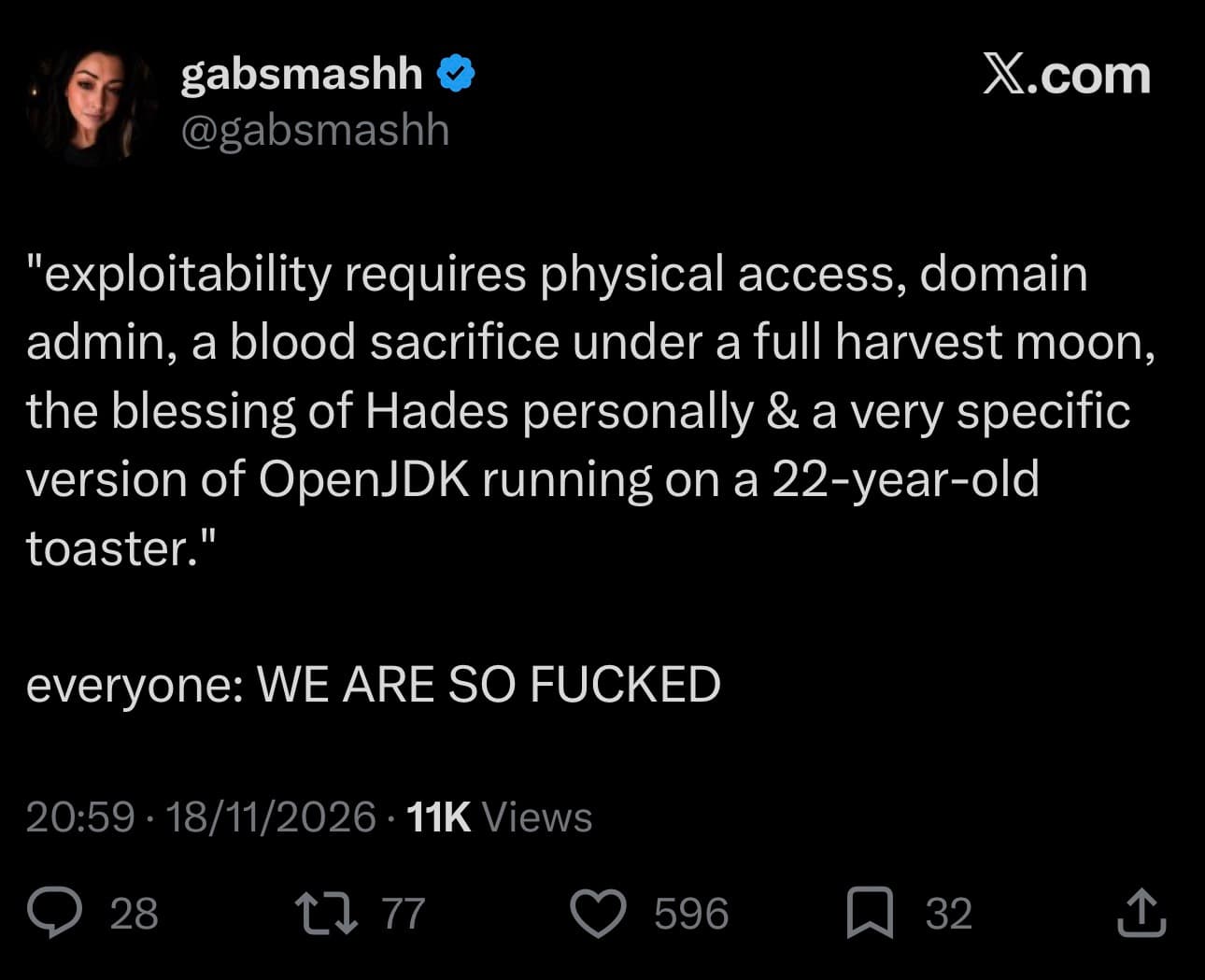
The post by @gabsmashh on X, 18 November 2026. Exploitation would require physical access, domain admin rights, a blood sacrifice under a full harvest moon, the personal blessing of Hades and a very specific version of OpenJDK running on a 22-year-old toaster. Then, everyone: we are so fucked.
I run security for a company, and alerts are part of my job. What wears me down is the funfair they have turned into. Every flaw arrives with a stage name, a 9.2 and a headline counting its victims in the hundreds of millions, and it is my team that pays for the ticket. Meanwhile the flaws attackers genuinely use slip under the door, unnamed, and sometimes with a score of 2.7.
What is an alarm worth when it rings nineteen times out of twenty with no fire?
Since 2018, 36,869 flaws have been scored critical, at 9 or above out of 10. On Thursday, Jeremiah Grossman, founder of WhiteHat Security, set that figure against VulnCheck's catalogue, which records flaws with reported exploitation: only 1,967 carry the trace. Nineteen red alerts out of twenty have therefore never seen a reported attack. Citing Dave Kennedy, founder of TrustedSec, he drew a conclusion I will sign twice over: the permanent fire drill is unjustifiable, and everyone has had enough of it.
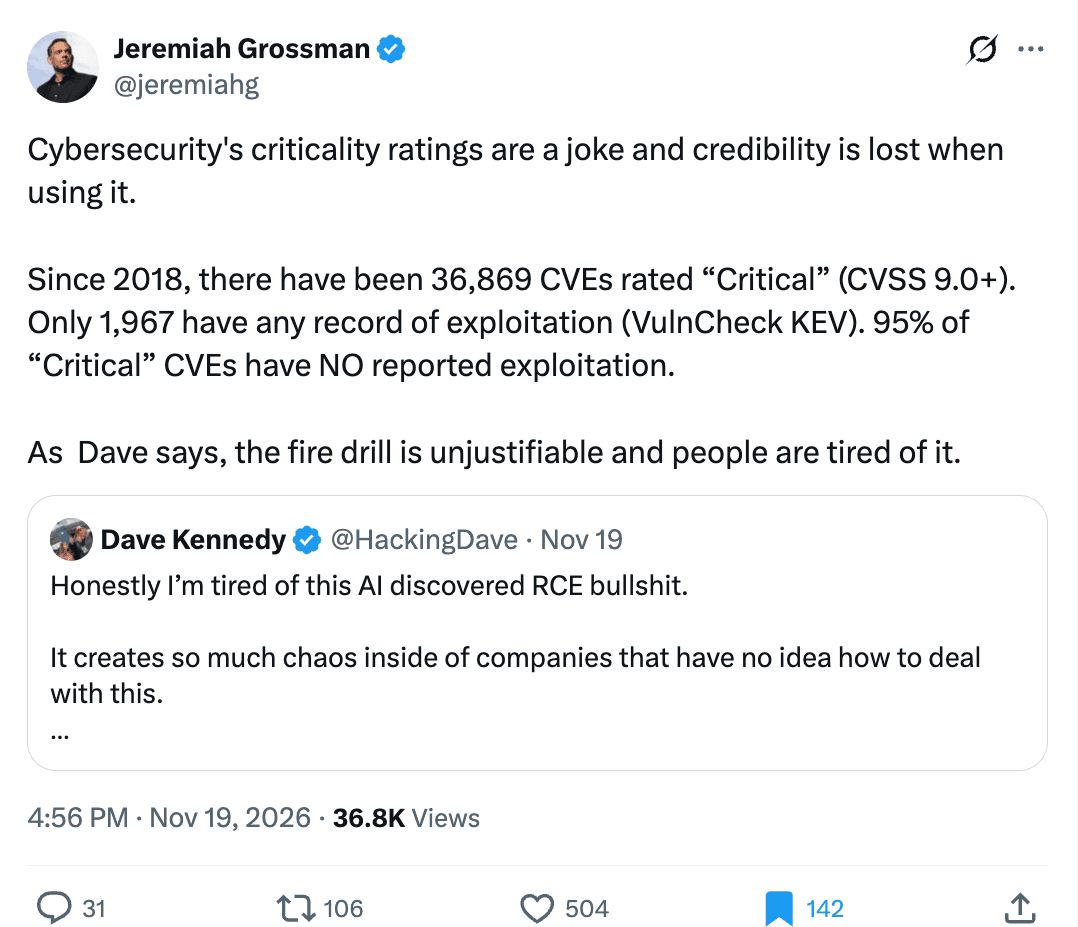
Jeremiah Grossman's post on X, 19 November 2026: 95% of flaws scored critical since 2018 have no reported exploitation.
I often use the building comparison when I speak at conferences. Nobody would accept a block of flats with no extinguisher and no fire door on the grounds that the risk is "accepted, 2027 budget". Nobody would keep a fire alarm that rings nineteen times out of twenty with no smoke either: the building manager would have it replaced within a month, and the residents would long since have learned to finish their coffee before going downstairs. In cybersecurity, we keep the alarm and buy a second one.
The trade calls this flood the vulnpocalypse. On 13 November, the count of flaws published in 2026 passed 100,000, more than double last year, driven by artificial intelligence tools combing through code at scale. The share of those flaws with confirmed exploitation has not moved, around 1.4% at VulnCheck. AI multiplies alerts far faster than attacks, and the apocalypse is mostly taking place in the inboxes of security teams.
The 9.2 that asked for a toaster
Java4Shell, patched on 17 November, is scored 9.2 by Calif, the company that found and named it, and 8.1 by Oracle, which publishes Java and records a high attack complexity. It was Calif's score that went round the alerts, and the pupil's corrected copy was preferred to the teacher's. The offending code only runs on processors carrying a particular instruction set, present in some Intel Xeon servers and in recent generations of AMD processors. ARM processors and most recent Intel laptops escape it. On an affected machine, crashing Java is easy, and taking control of it additionally requires a memory leak specific to the target.
NGINX2Root, published the next day, gathers ten flaws in the NGINX web server, five of them scored 9.2. To execute code, the published attack requires an x86-64 server, HTTP/2 enabled with no proxy in front, memory addresses harvested from the server's responses and roughly 128 gigabytes of traffic sent in under an hour, about thirty high-definition films dispatched to the same server by an attacker counting on going unnoticed. The 225 million sites quoted in several headlines correspond to NGINX's market share, and nobody has published the number of servers meeting all those conditions.
On 10 November, Vite, the tool used to develop a good share of the web's applications, had opened the show with a flaw scored 9.1, relayed across social media with a generous helping of flashing lights, emoji explosions and "Patch immediately". It only affects the development server, when somebody has explicitly opened it to the network, since Vite listens only on the developer's own machine by default. The advisory did not even carry a CVE number.
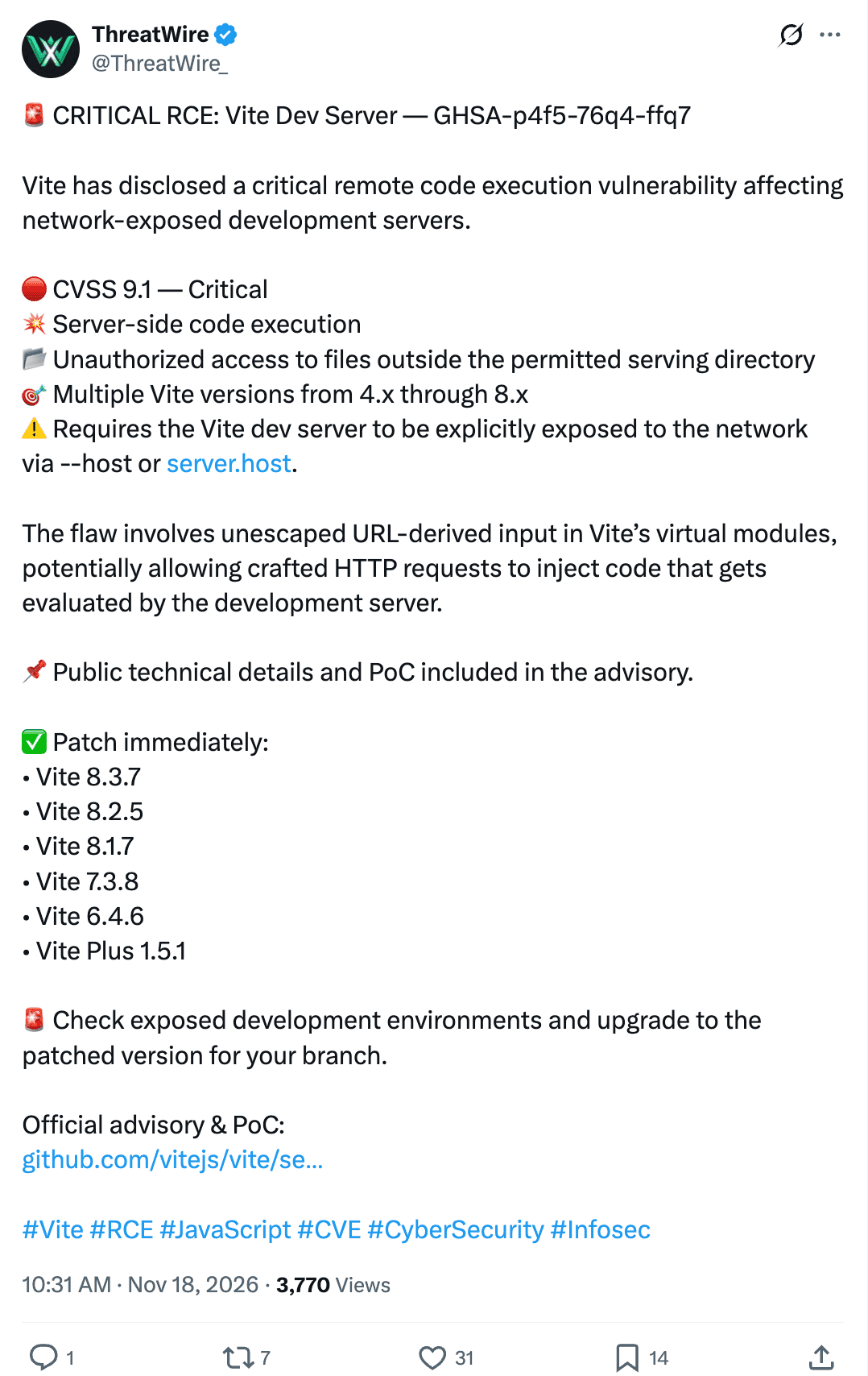
ThreatWire's post on X, 18 November 2026, eight days after the advisory. The condition that decides everything, a development server explicitly opened to the network, arrives as the fifth point, after the score, the explosion, the folder and the target.
None of the three was being exploited as of 19 November. The name and the score are written for the headline, and the conditions for exploitation are buried in the advisory's sixth paragraph, where the hurried reader never arrives. The gabsmashh notice was barely an exaggeration.
The 2.7 that switched off the lights
Broadcom scores VMware ESX flaw CVE-2026-41709 at 2.7 out of 10. ESX is the hypervisor running the virtual servers of a good share of the corporate world. The flaw lets somebody who already holds administrator rights on the host carry out certain operations without them appearing in the logs. On 28 October, CrowdStrike revealed that Warp Panda, a China-linked group, had used it as a zero-day at the start of 2026, during espionage intrusions against American law firms, precisely to reduce what the audit trail would show. Broadcom had published the patch on 29 July. CISA added the flaw to its catalogue of exploited flaws on the day CrowdStrike published, with a federal deadline of 11 November.
I covered it in the GRC Brief of 2 November, the Cyber Academy letter, and the lesson goes well beyond VMware. You can calibrate your log retention period perfectly, consult your data protection officer, document the purpose and the duration, and still be blind, because somebody cut the recording from under you, at the hypervisor level. The compliance file was immaculate, and it could see nothing.
Now look at what your own process would have done with it. A 2.7 falls below the floor of most patching policies, it would never have been queued. The same Broadcom advisory patched vCenter flaws scored 9.8: a team sorting by score fixed those first, applying its rule scrupulously, and set aside the only one serving spies. Nothing moved for three months, until an intelligence report named the group, and Broadcom kept the "Low" label after the revelation.
The score gets it wrong in both directions. It screams for Java4Shell and it whispers for Warp Panda, and a policy sorting by threshold hands its security to the barkers on one side and the spies on the other.
Who profits from naming a flaw?
Heartbleed, in 2014, earned its name, its logo and its website: an easy flaw to exploit, which exposed the memory of servers worldwide. Log4Shell, in December 2021, earned its own. Since then, the name has become a product. Calif named Java4Shell by borrowing the suffix of Log4Shell, a Java flaw like itself, and the memory of Christmas 2021 spent hunting Log4j across servers did half the work. Xint named NGINX2Root, and within forty-eight hours Tenable, Qualys, watchTowr, Upwind and Rapid7 had published their analysis, most of them carrying a passage on how their own tools spot affected servers. VulnCheck called these launches "marketing exercises" in a post that announced, a few lines further down, a Java4Shell exploit reserved for its paying customers. Even the funfair's critic runs a stall there.
Finding flaws is useful work, and I know of none more necessary right now. Selling them as disaster films is a different trade, and it pays better. A named flaw picked up by the whole specialist press is worth an advertising campaign, and AI, which let Calif write its first Java4Shell exploit in roughly two hours, is going to multiply the candidates for casting. Every month will bring its star, and every star its week of panic.
The noise now arrives through clients
This month, for the first time since Log4Shell, clients contacted us repeatedly to ask whether we had patched. One of them now does it for every critical flaw announced. The noise from vendors and the press is travelling down the supply chain, and every client relays it to their suppliers without asking the only useful question: is this flaw genuinely critical, and for whom?
I understand the reflex. NIS2 and DORA require companies to control the security of their suppliers, and the message sent for every headline gives the impression of discharging that duty. That client will never ask the question that would have counted in the spring: can your hypervisor logs be cut without you seeing it? They mobilise for the headline act while the attack goes through the back of house.
For my teams, each chaser adds to a week already taken up by the star of the moment, and calls for a written answer, often one more check. The fatigue is real, and it carries a cost nobody puts a number on. A team that is told the wolf is coming every week eventually stops hearing it.
The wolf does come sometimes
None of this licenses ignoring an alert. PHP2Shell had a stage name, a 9.2, and it bit: Amazon's decoy network caught an exploitation attempt on 17 October, four days before the patches, and CISA added it to its catalogue of exploited flaws. Here, we were exposed, we knew it, and we patched urgently, within twenty-four hours. I wrote in October that this mobilisation was warranted, and I would do exactly the same again.
Exposed development servers are no fantasy either. In August, another Vite flaw, scored 7.5, fed a cloud credential theft campaign against them, according to the Cloud Security Alliance. That day, the wolf came through a flaw nobody had called critical.
PHP2Shell and Java4Shell carried the same 9.2. What separated them came down to two questions: are we exposed, and is somebody already using it? Those two questions are what we rebuilt our handling of alerts around.
What actually protects you when the alert lands
We realigned the process first. When an advisory lands, responsibility for the analysis sits with the cybersecurity team, which checks exposure against our software bill of materials, the list of what actually runs inside our applications, known as the SBOM, with our tools, and by asking the developers and engineers concerned directly.
Tools are not enough. For the Vite flaw, the tool our security rests on, one of the best on the market, took twenty-eight hours to detect it after the advisory was published. Twenty-eight hours is enormous, when PHP2Shell was being exploited before its patches were even out.
Then comes a single question: is the flaw exploitable here? If it is not, it enters the ordinary patching cycle. If it is, as PHP2Shell was, it goes to emergency patching within twenty-four hours. The score out of 10 and the stage name are not among the criteria.
The ESX flaw imposes three further requirements on me. The first is the absence of a floor: a low-scored flaw touching logs, identities or internet-facing equipment deserves the same examination as a 9.2, and it goes to emergency as soon as exploitation is reported. The second is a rule decided once, approved by the board and applied without renegotiation for every headline, which lets you answer the client who writes in for every alert with the rule itself rather than a yes or a no. The third is an architecture where one flaw is not enough to lose everything: an exposed server must not reach the directory or the production databases directly, and logs must leave for a system a hypervisor administrator does not control.
The day a 2.7 switches off your logs, nobody will say here we go again. Nobody will say anything, because nobody will have seen it.
Further reading
- We fix whatever makes noise
- We accept cyber risk the way we pick the plant in reception
- Nobody gives Microsoft orders, not even the state
- NIS2: the state will demand of directors the seriousness it spares itself
- Cyber blackout: Sweden got its supermarket tills ready, France published a PDF
- Cybersecurity must not become an election issue
- Practical steps to protect yourself on etrecyber.fr
Sources
- @gabsmashh, post published on X on 18 November 2026; Jeremiah Grossman, post published on X on 19 November 2026, quoting a post by Dave Kennedy from the same day; ThreatWire, post published on X on 18 November 2026.
- The Register, This year's bug count just passed 100K, 13 November 2026, with VulnCheck data.
- Help Net Security, Java4Shell OpenJDK flaw: Exploitation is tricky and hinges on specific CPUs (CVE-2026-114938), 18 November 2026; VulnCheck, Caitlin Condon, Java4Shell CVE-2026-114938: Fine, I Guess We'll Do This Again, 17 November 2026.
- F5, advisory K000164058, 18 November 2026; Tenable, NGINX2Root FAQ: Five vulnerabilities in NGINX (CVE-2026-123007), 18 November 2026; watchTowr, NGINX2root (CVE-2026-123633) FAQ, updated 19 November 2026; Qualys, NGINX2Root: Five nginx Flaws, Led by CVE-2026-123007, 18 November 2026; Shattered, analysis of the 225 million sites figure, November 2026.
- Vite, security advisory GHSA-p4f5-76q4-ffq7, 10 November 2026; SecurityOnline, Vite Dev Server RCE (CVSS 9.1): PoC Published, 18 November 2026; Cloud Security Alliance, Vite Dev Server Flaw Fuels Mass Credential Harvesting, 16 September 2026.
- Broadcom, advisory VMSA-2026-0006, 29 July 2026, revised 19 August 2026; CrowdStrike, 2026 Legal Threat Landscape Report, 28 October 2026; The Hacker News, China-Linked Hackers Exploited VMware ESX Zero-Day to Reduce Audit Trail Visibility, 29 October 2026; Cloud Security Alliance, Blind Hypervisors: Warp Panda's Low-Severity ESX Logging Zero-Day, 30 October 2026; Cyber Academy, The GRC Brief, edition 22, 2 November 2026.
- Amazon Threat Intelligence, Amazon Threat Intelligence identifies PHP2Shell exploitation prior to public disclosure in MadPot, October 2026; The Register, CISA confirms PHP2Shell under attack as researchers clock successful exploits, 27 October 2026.
- CISA, Known Exploited Vulnerabilities Catalog; CERT-FR, security alerts.
Frequently asked questions
What is the vulnpocalypse?
The word, a contraction of vulnerability and apocalypse, describes the explosion in flaws discovered and published since artificial intelligence tools started hunting for them at scale. By 13 November 2026, more than 100,000 CVEs had been published during the year, more than double 2025. The share of those with confirmed exploitation stays low, around 1.4% according to VulnCheck.
What is Java4Shell, and is my computer affected?
Java4Shell is a flaw in the Java virtual machine (CVE-2026-114938), patched on 17 November 2026. It only triggers on processors carrying the AVX-512 VBMI instructions, found in some Intel Xeon servers and in AMD Zen 4 and Zen 5 processors, and it targets a Java application processing attacker-supplied data, which concerns servers first. Apple silicon Macs and most recent Intel laptops are not affected.
What is NGINX2Root?
NGINX2Root refers to ten flaws in the NGINX web server patched by F5 on 18 November 2026, five of them scored 9.2 out of 10. Code execution requires an x86-64 server, HTTP/2 enabled with no proxy in front and roughly 128 gigabytes of traffic. Rapid7 published a full exploit, which justifies patching internet-facing servers with HTTP/2 enabled quickly.
What does a flaw's CVSS score mean?
The score comes from CVSS, the standard severity scale. It describes what an attacker would obtain in the scenario most favourable to them, without weighing how likely that scenario is in your estate. Since 2018, around 95% of flaws scored critical have no reported exploitation, and two bodies can score the same flaw differently: Java4Shell is 9.2 for Calif and 8.1 for Oracle.
Should you patch a flaw scored low?
Yes, when it touches logs, identities or internet-facing equipment, and urgently as soon as exploitation is reported. VMware ESX flaw CVE-2026-41709, scored 2.7, let an espionage group hide its operations in hypervisor logs, and CISA set 11 November 2026 as the patching deadline for US federal agencies.
How can you tell whether a flaw is actually being exploited?
Three sources carry weight: CISA's KEV catalogue, which lists exploited flaws, CERT-FR alerts, reserved for exploited flaws or systemic risks and distinct from its ordinary advisories, and the vendor's own statements. A high score, a brand name or an alarming headline tell you nothing about exploitation.

The author
Christophe MazzolaI write about cybersecurity as it's actually lived: governance, the human factor, and everything audit reports don't dare tell the board. Author of « Être en cybersécurité ».

Être en cybersécurité
A cyber roadmap in plain language, for everyone, not just the experts.