The thief took everything but the moon
On 25 September the Académie Goncourt withdrew Thélyson Orélien's novel, four days after he was accused of having written it with an artificial intelligence. Since then, texts he signed and other people wrote have surfaced almost daily, from a 2010 poem lifted from a Zen monk to opinion pieces translated from the Philippine press. All of it could have been checked for sixteen years with a search engine and a local library, and not one of his publishers bothered.
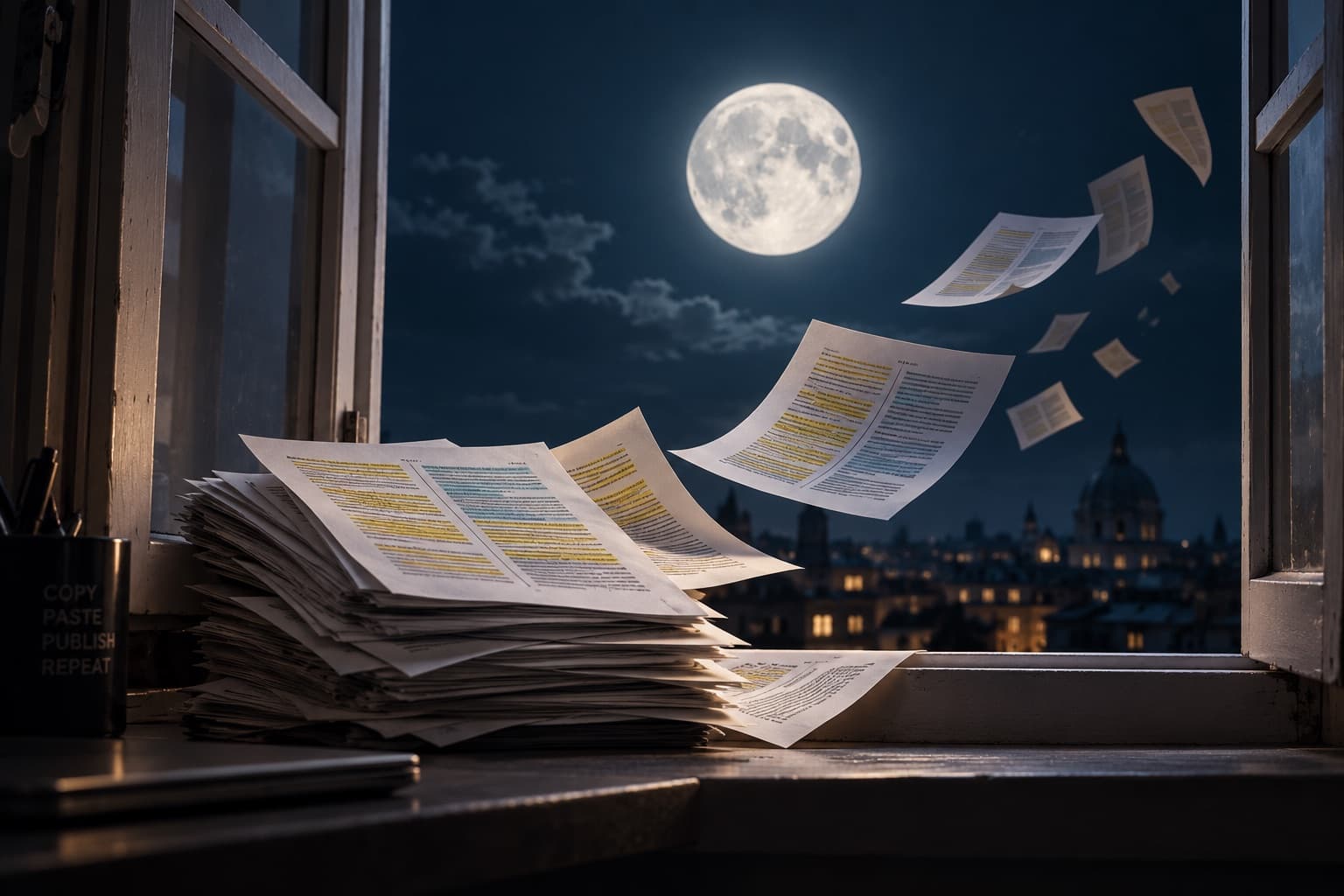
On 12 January 2010, an earthquake devastated Haiti. That same year, Thélyson Orélien, born in Haiti in 1988 and settled in Quebec after the disaster, published a poem on his blog titled « Déchirures ». In it the earthquake carries everything away, except the moon that was at the window.
The moon and the window belong to Ryōkan, a Zen monk who died in 1831. His best-known haiku in French tells of a thief who took everything away, except the moon, and it closes the Anthologie de la poésie japonaise classique translated by Gaston Renondeau for Gallimard, on page 253. Orélien replaced the thief with the earthquake and copied the rest. For the final stanza he went back to page 184 of the same volume, where the poet shogun Minamoto no Sanetomo, assassinated in 1219, describes waves breaking on the shore into tears, into fractures and into spray. The three words are taken up in the same order, and the first one serves as the title. According to Thomas de Montessus, who published the comparison on 27 September, the middle stanza comes from Ono no Komachi, a ninth-century poet.
The disaster that struck his own country, Orélien set to verse using the words of three Japanese poets dead for centuries.
Sixteen years of texts signed Orélien and written by others
The 2010 poem is no youthful accident, since the method turns up in everything unearthed over the past week. On 28 February 2013, La Presse published an Orélien opinion piece titled « Ne mettons pas nos héros sur un piédestal », about Lance Armstrong, Oscar Pistorius and Tiger Woods. Five days earlier, Dean Andy Bautista had published a text on the same subject in The Philippine Star. Orélien takes up the substance of it, some paragraphs within a few words once translated from English. La Presse today leaves the piece online with a plagiarism notice, and François Cardinal, its vice-president for information, calls the affair a deception that is disappointing and inexcusable.
On the RFI blog platform, a column drawing a parallel between Barack Obama and Trayvon Martin reproduces at least four paragraphs translated from Portuguese without the slightest retouching, from a text by Gilberto Rodrigues put out a few days earlier by the Pressenza agency. La Presse found further borrowings from the Peruvian daily La República and the Indian paper The Hindu. Franceinfo flags a November 2014 post on the Club de Mediapart. The short story that won him the Radio-Canada audience prize in the early 2010s takes passages from Le Matin des magiciens, by Louis Pauwels and Jacques Bergier. Radio-Canada counts at least five texts from 2012 and 2013 partly copied, and Thibaut Giraud, known on X as Monsieur Phi, has documented others, translated from English and Spanish.
The choice of sources shows the method was deliberate. A Manila daily, a Lima paper, a Lusophone agency: nobody in Montreal or Paris was reading those texts, and the comparison tools of the day looked for matches within a single language. Translating was enough to erase the trace. For poetry, a 1971 paperback that no blog reader would ever open did the job.
Why does his defence answer no comparison at all?
Since 21 September, Orélien and his publishers have said a great deal. Grasset denounced a hate campaign. Boréal issued a statement saying the editorial work had been done without any AI involvement. The author told La Presse that his first manuscript was finished in 2019, then told Libération that he did not see why he would have needed a machine and that he was assembling a file to prove it. On Thursday 24 September, he told AFP there was a desire to silence him.
None of those statements answers the substance of the plagiarism, which is the only established fact. La Presse, Radio-Canada and franceinfo all approached him, with no answer at the time they published. A man confronted with paragraphs translated word for word from the Philippine Star has little to offer in reply, and the story of persecution stands in for one.
As for the announced file, it is simple to assemble for an author telling the truth, and I speak from experience. Before Être en cybersécurité came out in March 2025, Éditions Spinelle asked me for exactly those items to satisfy themselves that I was the author of my own book: dated files, successive versions, working correspondence. A manuscript finished in 2019 leaves the same traces, and forty-eight hours is enough to gather them and hand them to a bailiff or a journalist. If Boréal or Grasset made the same request of their author, they hold the file, and nothing stops them from publishing it. I have found no trace of any such publication as of this writing.
What is Orélien's word worth when he swears he used no AI?
The Pangram detector, on which the initial accusation by the anonymous account Balance ton Claude rested, remains a statistical tool. The researcher Marzena Karpinska, who evaluated it, measured a false positive rate of 2 %, well below its competitors, and independent evaluations remain rare. A score, even repeated across dozens of extracts, does not on its own prove that a text was generated.
The main technical objection collapsed within days. The writer François Negroni argued that Orélien's language, which critics describe as creolised and shot through with Spanish and Portuguese, was skewing the detector. The Décrypteurs team at Radio-Canada submitted eight books by authors of Haitian origin to Pangram, including Lyonel Trouillot, Marie-Célie Agnant and Jacques Roumain, along with a novel by Blaise Ndala. All were classified 100 % human. I submitted my own book to the same tool this week, and most of its sections also come back 100 % human. One book does not make a study, but the result matches that of the Décrypteurs. The Académie Goncourt then based its decision on the plagiarism and on convergent analyses by researchers and journalists.
That leaves the author's word, and this is where auditing has something to say. The international standard ISA 240, which governs how fraud is handled in the audit of financial statements, requires an auditor who uncovers fraud involving management to reassess the reliability of every representation that management has made. A letter of representation signed by a director caught falsifying the books is worth nothing as audit evidence. Only verifiable documents count from then on.
Applied to Orélien, the rule gives a result with no appeal. « I did not use AI » is a management representation, issued by someone who for at least four years signed texts translated from the foreign press and presented them as his own. The assurances from Boréal and Grasset are worth no more, since neither house had spotted the plagiarism and neither could therefore guarantee anything about their author's working method. The use of AI remains to be demonstrated, and the burden of proof now sits with the man who lied for sixteen years about where his sentences came from.
Why did nobody check for sixteen years?
The list of those who published, awarded or edited him without checking anything is long. La Presse carried his texts until August 2026. RFI hosted his columns, a Radio-Canada jury gave his short story a prize, Boréal and then Grasset signed his novel, the Fnac crowned it, and four Paris juries, those of the Goncourt, the Médicis, the Femina and the Renaudot, had shortlisted it. Each of those institutions assumed the previous one had done the work.
François Cardinal acknowledged it plainly: « Our doubts about Thélyson Orélien's approach regarding his use of AI led to the discovery of plagiarism. » In other words, La Presse published this author for thirteen years, and it took a suspicion of an entirely different nature to make it finally run the search it could have run from the first opinion piece.
I call that a decision gap: the risk has been identifiable for a long time, the means of handling it exist, and nobody has been given the job. In the organisations I audit, that is almost always how a serious incident begins. The control had no owner, everyone assumed somebody else was handling it, and it took an outside event for anyone to look.
The fashionable tool did the work of a control nobody had put in place
Cybersecurity knows this film by heart. An organisation discovers a new threat, buys the tool that promises to detect it, and leaves the elementary controls untended. On 4 September 2026, the Association des maires de France confirmed an SQL injection intrusion on its website, a technique publicly described since the late 1990s. The attacker claims 114,000 rows, the AMF speaks of more than 100,000 records without counting people, and one of the stolen tables held passwords stored in clear text. That same month, the sector's conferences were talking about AI-driven attacks.
The Orélien affair followed the same slope. For two days the debate was about the reliability of an AI detector, while documentable fraud lay sleeping in the archives of La Presse, RFI and Mediapart. The detector served as an alarm, and the proof came from a text comparison any intern could have run in 2013.
What would have stopped Orélien in 2012
A publisher signing a first novel should run the manuscript and the author's earlier publications through a multilingual comparison tool before signing. Language models make it trivial today to match a French text against its English, Spanish or Portuguese source, so the very technology suspected in this affair would have unmasked its author in an afternoon. That check belongs in the editorial process, backed by the warranty of originality that publishing contracts already provide for.
A daily that publishes outside opinion pieces should check, at least by sampling, the originality of texts from its regular contributors. La Presse published Orélien for thirteen years without ever doing so.
A jury that sets a book aside should publish what its decision rests on. The Goncourt was right to withdraw the novel, and it should now make public the analyses it calls convergent, with the names of their authors.
Orélien, finally, has a simple way to save what can be saved: publish the dated files of his 2019 manuscript, and answer, text by text, on the plagiarism. Until he does, his novel remains the work of a man who took his words from other people every single time anyone was able to check.
Ryōkan's haiku has been online under Orélien's name since 2010, the piece translated from Manila since 2013, the Mediapart post since 2014, and it took an anonymous account accusing a machine for a reader to finally open page 253.
Further reading
- The threat that has never claimed a victim, and comes back on the evening news every summer
- France's tax authority knew in late June. You found out on 13 August
- Cybersecurity must not become an election issue
- Practical steps to protect yourself day to day: etrecyber.fr
Sources
- Thélyson Orélien, « Déchirures », poem published on his blog in 2010, consulted on 27 September 2026.
- Thomas de Montessus, post on X of 27 September 2026 comparing « Déchirures » with its Japanese sources.
- Gaston Renondeau (trans.), Anthologie de la poésie japonaise classique, Gallimard, coll. Poésie / UNESCO, 1971, repr. 2016, pp. 184-185 (Minamoto no Sanetomo) and p. 253 (Ryōkan).
- La Presse, Thélyson Orélien rattrapé par un passé de plagiaire and L'affaire Thélyson Orélien en six questions, 23 September 2026, and statements by François Cardinal carried by AFP.
- Radio-Canada, Les Décrypteurs, Après l'IA, Thélyson Orélien visé par des allégations de plagiat, September 2026.
- Le Devoir, Déjà dans la tourmente, l'auteur québécois Thélyson Orélien est accusé de plagiat, September 2026.
- franceinfo, Peut-on se fier aux détecteurs de textes écrits par IA comme Pangram ? and article on the plagiarism suspicions covering other texts, September 2026.
- RTBF, Controverse Thélyson Orélien : ce qu'il faut savoir sur Pangram, September 2026, for the Décrypteurs test and the Marzena Karpinska results.
- Académie Goncourt, statement sent to AFP on 25 September 2026, reported by Le Monde.
- Association des maires de France, confirmation of the incident of 4 September 2026, recorded by the blog Ostraca, Fuites de données : chronologie France & Europe.
- IFAC, international standard on auditing ISA 240, The Auditor's Responsibilities Relating to Fraud in an Audit of Financial Statements.
Frequently asked questions
Did Thélyson Orélien write his novel with an artificial intelligence?
Nothing demonstrates it to date. The accusation rests on results from the Pangram detector and on analyses by researchers that the Académie Goncourt considers convergent. The author denies it and says he has a manuscript completed in 2019, which he has not made public.
What has been proven against him?
Repeated plagiarism between 2010 and 2014: a poem assembled from three Japanese poets, at least five opinion pieces translated from foreign articles, and a prize-winning short story that borrows from *Le Matin des magiciens*. Each case is demonstrated by direct comparison with an earlier text.
Is it not dangerous to accuse an author on the strength of a detector?
For an author with no record, yes, because a score proves nothing and it is impossible to demonstrate that a text never passed through a machine. Orélien's case is different, since the Goncourt decision also rests on established plagiarism and his word has lost all evidential value. The detector acted as an alarm, and the proof came from elsewhere.
Without the AI accusation, would the plagiarism have been found?
Probably not this year. La Presse acknowledges that its doubts about AI led it to the plagiarism. What that says above all is that its own checks had never worked in thirteen years.
Is plagiarising a text illegal?
Yes. French law does not treat plagiarism as a standalone offence, it qualifies it as contrefaçon under Article L. 122-4 of the intellectual property code, which forbids any reproduction, even partial, without the author's consent. Translation changes nothing about that classification.

The author
Christophe MazzolaI write about cybersecurity as it's actually lived: governance, the human factor, and everything audit reports don't dare tell the board. Author of « Être en cybersécurité ».
Être en cybersécurité
A cyber roadmap in plain language, for everyone, not just the experts.