Fine for X, offensive against Telegram: Europe is waging war on digital freedom
On Friday 5 December 2025, the European Commission fined X, Elon Musk's platform, 120 million euros. On the surface: a simple slap on the wrist for failing to comply with the Digital Services Act (DSA). In reality?
On Friday 5 December 2025, the European Commission fined X 120 million euros, Elon Musk's platform. On the surface: a simple slap on the wrist for failing to comply with the Digital Services Act (DSA). In reality? A frontal attack on the last major platform where speech is not moderated on demand.
And while the media applaud what they call a regulatory victory, another event, passed over in silence, deserves just as much attention: Pavel Durov, founder of Telegram, placed under formal investigation in Paris for refusing to install automated censorship tools.
Two platforms. Two visions. Two sanctions. One single logic: punish those who resist the ideological standardization imposed by Brussels.
Why did the European Commission fine X 120 million euros?
The fine of 5 December 2025 is the very first non-compliance decision handed down under the DSA. It rests on three grievances:
- a paid blue badge system judged deceptive, the check mark once reserved for authenticated accounts now being sold to anyone who pays for a subscription,
- an incomplete advertising repository, with missing data and excessive processing times,
- data access that is too restricted for researchers, which prevents them from monitoring the platform independently.
But none of these points is unique to X. Meta, TikTok and Google do exactly the same thing, sometimes worse, without being fined. The only difference? X does not obey.
Since Musk took over Twitter, he did not just buy a company. He took back control of a digital space where speech could once again step outside the frame validated by the elites. The result: Brussels never digested that slap in the face. This fine is not a legal act. It is a political warning shot.
And X sees it no differently. On 21 February 2026, the platform filed an appeal before the courts of the European Union, denouncing an "incomplete and superficial investigation", "serious procedural errors" and "systematic breaches of the rights of the defence". It is the first legal challenge ever brought against a DSA fine, and it will set a precedent.
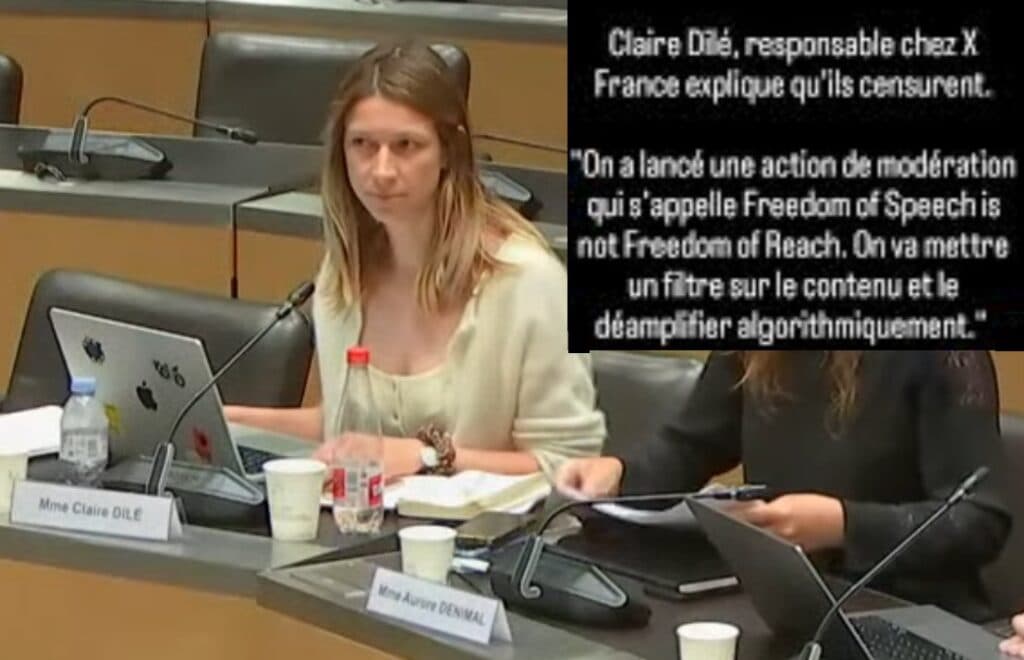
Claire Dilé, X's French dead weight
In this explosive context, the stance of X's French leadership is quite simply disastrous. Claire Dilé, head of public affairs at X France, publicly acknowledged that moderation measures "adapted to the local context" were being applied.
Translation: X quietly moderates in France to please the authorities.
She speaks of "partial shadow bans" as a necessary evil. A staggering admission that directly contradicts the doctrine Musk displays internationally.
This is no longer just a conflict between Brussels and a company. It is an internal conflict.
On one side, a global boss who campaigns for free speech without filters. On the other, a local leadership doing quiet damage control to stay in the administration's good books.
And this double-speak weakens any strategic defense of X. It validates the EU's criticisms, hands ammunition to the censors, and suggests that the platform can be "brought back into line" country by country.

Why was Pavel Durov placed under formal investigation in France?
While X is taking fines, Pavel Durov, founder of Telegram, was arrested at Le Bourget airport on 24 August 2024. Placed under formal investigation four days later on twelve counts, including complicity in the distribution of child sexual abuse images and in drug trafficking, for failing to moderate, he was put under judicial supervision: five million euros bail, an obligation to report to the police twice a week, and a ban on leaving the country. That last measure was only lifted in November 2025.
Why such severity? Because Telegram still refuses to install proactive moderation tools on its messaging services.
In other words: because it respects encryption.
Durov did not give in. He held his line. The result?
- judicial supervision and record bail,
- pressure to moderate more harshly,
- the threat of being banned in Europe.
Once again, the problem is not the content. It is the disobedience. Telegram, like X, does not want to hand the EU the right to define what may or may not be said. And for that, it is being dragged through the mud.
Does the DSA regulate speech or standardize it?
The Digital Services Act had been presented as a response to the excesses of the GAFAM. On paper, it requires very large platforms to be transparent, to open up their data and to remove illegal content, on pain of fines of up to 6% of worldwide turnover. In practice, it has turned into a machine for producing ideological compliance.
- Imposed audits,
- content takedowns within 24 hours,
- permanent accountability.
Free speech becomes conditional. And the slightest platform that does not fall in line becomes a problem to solve. The most worrying part? This regulatory framework does not go after deceptive content, but after the platforms that escape power.
What they don't tell you: the DSA, a tool of domestic geopolitics
Brussels does not go after TikTok. Brussels does not sanction Meta for its privacy violations. But Brussels punishes X for having given visibility to conservative, sovereigntist or dissident opinions.
And it is no coincidence that this fine comes right after a series of "unwelcome" posts about Ukraine, NATO, or migration policies.
Same scenario for Telegram:
- Does end-to-end encryption get in the way of surveillance?
- Out comes the "indirect complicity in terrorism" card.
They no longer target offenses. They target structural disobedience.
We are not "protected", we are being tested
X. Telegram. Others will follow.
This regulation is not trying to clean up the digital space. It is trying to standardize speech. To align platforms on a single line: that of authorized opinion.
What is troubling about Musk is not that he sells blue badges for 8 euros. It is that he refuses to act as the ideological police for Brussels.
What is troubling about Durov is not that he hosts extremist groups. It is that he refuses to hand over his users like cattle to the authorities.
📣 This is no longer a question of regulation. It is a question of the sovereignty of speech. And as long as Europe prefers compliance to freedom, the fines will fall on the rebels, never on the docile.
Christophe Mazzola, cybersecurity expert, author of "Être en Cybersécurité", advocate of a clear-eyed Europe.
Sources
- 120 million euro fine against X, three grievances and first non-compliance decision under the DSA, 5 December 2025: European Commission.
- France's reaction to the penalty: France Diplomatie, Ministry for Europe and Foreign Affairs.
- X's appeal before the European courts, 21 February 2026: France 24 and Social Media Today.
- Arrest, formal investigation and twelve counts against Pavel Durov, August 2024: Wikipedia, Arrest and indictment of Pavel Durov and Paris prosecutor's office, via TechCrunch.
- Lifting of Pavel Durov's ban on leaving France, November 2025: France 24.
Frequently asked questions
Why did the European Commission fine X?
On 5 December 2025, the Commission fined X 120 million euros under the DSA, its very first non-compliance decision. It holds three grievances against the platform: a paid blue badge system judged deceptive, an incomplete advertising repository, and data access that is too restricted for researchers.
Has X appealed the 120 million euro fine?
Yes. On 21 February 2026, X filed an appeal before the courts of the European Union, denouncing an "incomplete and superficial investigation" and "systematic breaches of the rights of the defence". It is the first legal challenge ever brought against a fine issued under the DSA.
Why was Pavel Durov placed under formal investigation in France?
The founder of Telegram was arrested at Le Bourget on 24 August 2024, then placed under formal investigation on 28 August on twelve counts, including complicity in the distribution of child sexual abuse images and in drug trafficking, for failing to moderate. Placed under judicial supervision with five million euros bail, he saw his ban on leaving France lifted in November 2025.
What is the Digital Services Act (DSA)?
The DSA is the European regulation on digital services, fully applicable since 2024. It imposes on very large platforms obligations of transparency, data access and removal of illegal content, on pain of fines of up to 6% of worldwide turnover.
Why is the position of X's French leadership criticized?
Claire Dilé, head of public affairs at X France, publicly mentioned moderation "adapted to the local context" and "partial shadow bans". For the author, this double-speak contradicts the free speech doctrine displayed by Elon Musk and weakens the platform's defense.
Does the DSA target illegal content or the disobedience of platforms?
Officially, the DSA targets illegal content and systemic risks. The author's thesis is different: the regulation would first hit the platforms that refuse to hand Brussels the right to define authorized speech, with X and Telegram serving, in his view, as a warning to the others.

The author
Christophe MazzolaI write about cybersecurity as it's actually lived: governance, the human factor, and everything audit reports don't dare tell the board. Author of « Être en cybersécurité ».

Être en cybersécurité
A cyber roadmap in plain language, for everyone, not just the experts.