"Risk accepted, 2027 budget": the state played for real the exercise I run on stage
At conferences, I run a building using the formulas we apply to cyber risk, and the room always ends up laughing at the same line: "no extinguisher, risk accepted, 2027 budget". In 2026, the French state published three documents on its own cybersecurity, a strategy, an autopsy and a crisis review. I read them together, and the headline measure that comes out fits in one sentence: 5% of each ministry's digital budget for cybersecurity, from 2027.
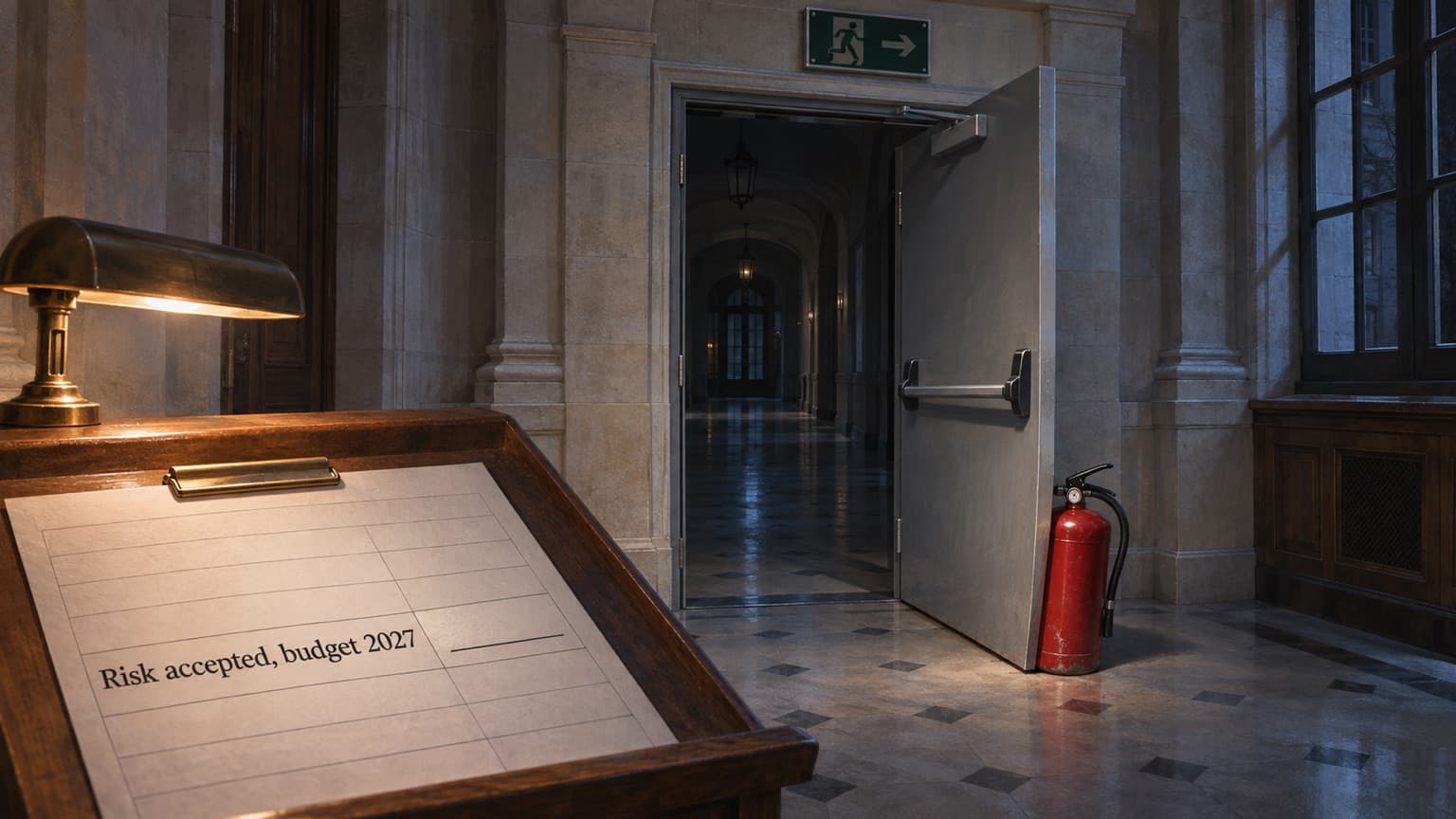
The exercise always starts the same way. I put up an ordinary risk register, the kind found in most of the companies I audit, and I replace "information system" with "building". Line 1: fire doors missing on the third floor, risk accepted, 2027 budget. Line 2: extinguishers past their service date, risk accepted, awaiting the next budget round. Line 3: emergency exit sealed for practical reasons, risk accepted by the head of facilities. The room laughs, because nobody would sign those lines for a building. The safety commission would rule against it, and the building would close.
Then I put "information system" back in place of "building". The room laughs less, because everybody recognises their own register.
This week I reread three documents the French state published in 2026 about its own cybersecurity. January's national strategy, ANSSI's September report on the hacking of the DGFiP, the tax authority, and November's situation update on operation REACTIV. I had not commented on the strategy when it came out. Read together, these three texts describe the building exercise played for real, with a fire in the middle of it.
The building, state edition
Keep the image and the three documents sort themselves.
The national cybersecurity strategy 2026-2030 is the planning permission. It says what the state wants to build, for whom, and with what ambition: making France a "first rank" cyber nation by 2030.
ANSSI's incident report on the DGFiP, no. 3033/ANSSI/SDO/NP, dated 23 September and published on the 29th, is the expert report after the fire. It traces how the fire got in, where it travelled, and why no alarm sounded.
The October REACTIV update, published on 12 November by CERT-FR, is the minutes of the emergency safety commission, the one convened after a fire to check floor by floor that the doors shut.
Between the three, one piece is missing that every building has and the state does not: the signed register of accepted risks, with a name, a criterion and a review date. That gap is what connects everything else.
The planning permission: a good strategy, with no safety commission
I will start with what the strategy does well, because it was too quickly reduced to "five pillars, no budget".
The text is serious. It wants to train and attract talent, including profiles these careers currently turn away. It plans a national prevention brand modelled on road safety campaigns, a crisis exercise programme, a trust label for organisations outside NIS2, a national portal that will absorb the 17Cyber service. Its fourth pillar is the strongest: support for the Cyber Resilience Act, coordinated vulnerability handling, open source security, post-quantum cryptography, digital identity presented as "a major lever against mass cybercrime". A CISO finds the right projects in it.
What is missing is what a safety commission would demand before opening the building. No objective is quantified. No deadline is set, beyond the 2030 horizon and the six months given to ministries to produce their roadmaps. The word "budget" does not appear. The word "minister" appears once, in a footnote about a European military network.
Then there is the plan of the common areas. On page 30, the governance diagram files state security under the mission "the state secures itself", steered by two interministerial committees, COSINUS and CINUS. DINUM, the agency that operates the interministerial network, does not appear on that diagram. The network itself is not mentioned anywhere in the thirty-six pages. Objective 5 does promise to "consolidate the state's shared digital foundation", without saying who owns it. In a building, that is the stairwell: it connects every flat, and it is not on the plan.
The text finally promised to raise the state to a level "able to withstand the most sophisticated threats". Hold on to that phrase. ANSSI will answer it eight months later.
A year ago, I wrote an open letter
On 10 November 2025, I published on this blog an open letter to Emmanuel Macron. It was one of my first pieces here, and I have no illusions about its readership at the Élysée. It serves me today as a grid, because it said what I expected from a state cybersecurity policy before the strategy appeared, and a year on I can set those expectations against the facts without rewriting history.
I asked first for a course that was "clear, stable, public", outliving a presidential term, without demanding new money. The strategy delivered the course, over five years, beyond the 2027 election. It also took the absence of budget literally, and the year showed that a course with no signatory and no indicator dissolves at the first incident into a succession of emergency plans.
I asked for digital systems to be treated as vital infrastructure, monitored continuously and not only in a crisis. ANSSI's report describes a tax portal the DGFiP's own security operations centre was not watching, and a national agency with no application-level monitoring over that perimeter. Continuous monitoring arrived in September, in the form of a crisis operation.
I asked for resources for town halls, hospitals and schools, where they are genuinely short. The Ministry of Education declared incidents in 25 of its 30 regional authorities between July and September, and it was through its compromised infrastructure that the attacker reached the tax authority.
I criticised unchecked subcontracting, citing the Corbeil-Essonnes hospital, entered in 2022 through a third-party account. In 2026, the DGFiP lost its land registry data through the computer of a chartered surveyor, and the family benefits agency lost close to 1.2 million holiday assistance files through stolen partner accounts.
I asked, finally, for authority to be given back to frontline IT directors. I come back to that later, because it is the request whose fate surprised me most.
The expert report: who signed, on what criterion, until when?
When I review a risk register during an audit, I ask three questions of every accepted line: who signed, on what criterion, and until when. I put all three to ANSSI's report on the DGFiP, and they describe a situation I often meet in the private sector, at a scale I had never seen.
DGFiP staff could reach certain work applications from their personal computers. According to the report, several dozen of their credentials were stolen in three months by infostealers, the spyware that harvests saved passwords, installed on devices the administration did not manage. ANSSI now recommends that using personal devices to reach work resources be "prohibited". Before the incident, somebody had accepted the opposite. The report does not say who.
Two portals, one of them giving access to sensitive resources, were reachable without strong authentication. A third, open to notaries and chartered surveyors, protected access with a code sent by email, which the attacker bypassed by compromising a surveyor's computer. The report calls these solutions "insufficient". Somebody had judged them sufficient.
The ADER portal, through which the data of the E-Contact application was siphoned, was not monitored by the DGFiP's security operations centre. ANSSI had no application-level monitoring there either. Unprivileged accounts could consult, in the report's words, "a significant volume of data", with no quota and no ceiling. Nobody wrote "portal unmonitored, risk accepted" in any register. That is nonetheless what happened.
The report concludes that the compromise "is not the consequence of a sophisticated attack, but of the exploitation of weaknesses in three areas": identity, architecture, detection. Set that sentence against objective 5 of the strategy. The state had prepared for the professional arsonist, and the fire came in through a door nobody had decided to shut.
In my piece about the plant in reception, I wrote that tacit acceptance is the most widespread form of cyber risk: a decision nobody took, but that everybody left in place. ANSSI's report is the best documented illustration of it I have read. The agency deserves credit for publishing it, including the passages where it admits its own instruments saw nothing.
The fire doors were propped open
The passage of the report that struck me hardest runs to a few lines, in the section on interministerial coordination. The attacker used the state's interministerial network to reach the ADER portal, and that use "was made possible by the compromise of infrastructure belonging to the Ministry of Education, itself connected to the network". The fire started in one flat and spread through the stairwell.
The report calls the network's segmentation, the digital equivalent of fire doors, "too permissive". And it adds a sentence no firefighter would want to read: blocking measures could have limited the exfiltration, "but a finer mapping of legitimate flows within the network is a prerequisite". In other words, the fire doors cannot be closed yet, because nobody knows precisely who should pass where. You cannot block the abnormal when you have never described the normal.
The October REACTIV update confirms the case is not isolated: at the Ministry of Education, the attacker's playbook ran as far as "lateral movement to other entities via the state's interministerial network". That network connects around 14,000 sites and a million users. It is operated by DINUM, a department of the Prime Minister's office.
I often tell the boards I advise that between not being blocked and blocking nothing lie two different worlds. The interministerial network was built to connect, and it does that very well. Nobody was ever tasked with deciding what it should not let through.
And the 15 August statement from the Prime Minister's office, which holds that "ministers are responsible for the data hosted within their ministry", reproduces exactly that division. Each tenant is responsible for their flat. Nobody is responsible for the stairwell, and the stairwell is how the fire travelled from the school to the tax office.
Decision lag, measured in hours
I call decision lag the gap between the moment an organisation knows about a risk and the moment it acts on it. It is usually measured in months, between an audit report and a budget line. ANSSI's report lets you measure it in days and hours, and that is the most useful part of the document for any executive.
A staff account is identified as compromised on 3 June, its password changes on the 12th. On 9 June, the Ministry of Education shares seventeen technical indicators with every ministry incident response team, among them an address used against the DGFiP two days earlier. Nobody makes the connection. On 15 June, a partner reports two compromised accounts to ANSSI, and the report notes that "the DGFIP does not reply and is not chased by the Agency".
Then comes the night of 23 to 25 June. At 20:50, an alert opens a ticket at the security operations centre on an account that the threat intelligence provider flags as stolen the same day. At 04:26, using that account, the attacker launches the extraction of E-Contact. At 10:40, the ticket is handled by resetting the password, which does not cut the open session. The extraction finishes on 25 June at 02:31. Eleven gigabytes left between 22 and 25 June, with no alert. An account reset on 7 June is reused by the attacker on 6 July, because changing a password does not clean the computer that leaked it.
Every signal was seen by somebody. None was converted into a decision within the window that would have mattered, because nobody was responsible for connecting what each of them saw.
In my team, when a security advisory lands, we own the analysis: we check our exposure through the software inventory, the tools, and direct questions to the developers. If it is exploitable here, the fix goes out within twenty-four hours. If not, it follows the normal cycle. I do not delegate that decision to a tool, because I have watched one of the best on the market run twenty-eight hours behind an advisory. ANSSI's report recommends quotas, correlation and session revocation. Those are good measures. They will only work if somebody, in each ministry, has the authority and the mandate to decide at nine in the evening that a suspect account is cut without waiting for the morning.
70% compliance, and one door that held
The October REACTIV update ends on a figure: 70% progress against the 2026 objectives of the state's digital security roadmap. It also counts 64 new security events since late September, 5 of them in ministries or bodies under their supervision, and notes a "significant decrease" over that perimeter, without quantifying it.
That 70% is a compliance indicator. It measures progress through a list of measures, at interministerial level, with no published method and no per-ministry detail. In August, writing about the DGFiP, I said that compliance had worked perfectly: it served to measure the reaction after the incident, not to prevent it. October's review extends that observation. Compliance produces documentary evidence on a date set by a third party. Resilience produces an operational state that depends on no calendar, and the same document gives two opposite examples of it.
At France Travail, a staff account was compromised "with validation of the second factor (SMS)", and the contact details of more than 60,000 staff and professionals were put up for sale. At the Ministry of Agriculture, compromised VPN certificates were spotted thanks to indicator sharing, and strong authentication stopped the attacker from connecting. Two organisations had ticked "two-factor authentication deployed". Only one had a door that shuts.
ANSSI says it in its DGFiP report: the second factor must survive the compromise of the first, and authenticator apps or physical tokens on a separate device are preferable. An indicator that counts an SMS code as protection secured is measuring compliance. The Agriculture case measures resilience. The next review should separate the two.
Why was the budget never the problem?
On 30 April, after the ANTS leak, Sébastien Lecornu announced 200 million euros drawn from the France 2030 programme and a standing rule: 5% of each ministry's digital budget devoted to cybersecurity, from 2027. Four days later, Anne Le Hénanff, the minister for digital affairs, explained on France Inter that the current share ran from 1% to 5% depending on the ministry, and that the required minimum was 10%. On 19 November, the reinforcement plan presented by the Prime Minister confirmed the trajectory: 5% in 2027, 10% in 2030.
Risk accepted, 2027 budget. The line that makes my conference rooms laugh has become the state's headline measure, and the minimum described in May has become the goal for the end of the strategy.
I do not believe money is the subject, all the same. Read back the list of failures in the report: a production portal that is not monitored, access permitted from personal computers, an emailed code judged sufficient, sessions that survive a reset, a report left unanswered. None of those decisions is expensive to correct. They belong to arbitration and documentation, and that is exactly what I have observed in government for years: the governance deficit owes less to funding than to the absence of somebody who decides and leaves a trace of what they decided.
I say the same to the CISOs I advise when they tell me their budget was refused. A plan that speaks in measures and frameworks loses the arbitration. A plan that speaks in taxpayer data exposed, services cut and ministerial responsibility wins it. A ministry spending 1% of its digital budget on security was not doing so out of poverty. Somebody judged each year that another project came first, without that decision ever being presented for what it was: the acceptance of a risk to the data of millions of French citizens.
Frontline IT directors got the liability, not the authority
In my 2025 letter, I asked for authority to be given back to frontline IT directors. The Resilience bill, passed in first reading by the National Assembly on 17 November, gave them something else.
An amendment from Philippe Latombe, who chairs the special committee, lets the financial courts sanction public managers who have failed to correct shortcomings identified by ANSSI. The member of parliament cites the example of a local authority IT manager leaving an already flagged weakness to drift. In the same text, the state and local authorities remain exempt from the financial penalties applying to companies, as I set out in my piece of 8 November.
I prefer a liability that exists to one that does not. But read the DGFiP report with that law in hand. No IT director decided alone that staff would connect from their personal computer, that surveyors would receive their code by email, or that the shared network would stay too open. The report itself concludes that its recommendations "will only succeed with the support of the whole business chain", of the ministry's hierarchy and of the interministerial level. ANSSI can prescribe. It cannot arbitrate, and it says so.
I have audited around a hundred public administrations in Wallonia, under a ministerial mandate. The mandate came from a minister, and the findings went back up to him, which gave the subject a political owner. That is what the three documents of 2026 lack. The strategy entrusts state security to committees, REACTIV to an agency holding emergency injunction powers, and the report to a hierarchy it does not name. The law passed in November adds a sanction for whoever executes, and no new obligation for whoever arbitrates.
Parliament has never been the CISO of a small business owner, and I keep telling companies that their responsibility waits for no vote. The same demand holds for the state. And so there is no misunderstanding, I have long argued that cybersecurity must not become an election issue. Tchap was made mandatory under François Bayrou, the strategy and the plans of 2026 bear Sébastien Lecornu's mark, and the state's exemption was already in the 2024 bill. What I am describing is structural, and I would write it in the same terms under any majority.
2027-2030: where do we want to be?
I could draw up the list of measures to take on Monday morning. It is in ANSSI's report, in April's roadmap and in every audit I have signed. The question that interests me lies elsewhere: the strategy runs to 2030, and nobody has said what state cybersecurity should look like by then.
The first condition is that all of it survives 2027. A presidential election falls in the middle of the strategy, and I know the usual sequence: a new government, a new strategy, new committees, and the counter reset to zero. That is why I keep saying cybersecurity must not become a campaign subject, since a campaign subject is redefined every five years. Defence has a military programming law, voted, multi-year, binding beyond a single term. State cybersecurity deserves the same treatment: a voted commitment, with resources and deadlines, that no change of majority can erase at a stroke.
The second, the one closest to my heart, concerns data. The strategy wants to generalise digital identity and writes as much: trusted identification means and "their generalised use". The state is therefore preparing to ask for ever more identity data, at the moment it has just demonstrated it cannot keep what it already holds. A name, a date and a place of birth stolen in 2026 will never change, and will remain exploitable in fifteen years. What is stolen encrypted today becomes readable the day a quantum computer can decrypt it. I argue for a state that is frugal with data, where every file must justify its existence, its access rules and its retention period. What the state does not hold, nobody can steal from it, and sovereignty begins with mastering what you hold, before any ambition to hold more.
The third concerns time. Artificial intelligence is accelerating attackers, as we heard again at the presentation of the 19 November plan, and the gap between the publication of a flaw and its exploitation is now counted in hours. The state, as we have seen, decides in days, sometimes weeks. By 2030, I would like us to stop measuring its security as a percentage of progress through a roadmap and to measure decision lag instead: the time between the alert and the cut-off, between the security advisory and the fix, between the report and the response. That is the only indicator the attacker is watching.
The fourth is continuity. In 2030, the question that will matter is this one: can the state keep paying salaries, disbursing benefits, opening schools and collecting tax for ten days with the network down? In early November, I wrote that Sweden got its supermarket tills ready while France published a PDF. What is needed is concrete scenarios, ministry by ministry, far from the grand crisis exercises staged for the photograph. Email is unavailable for eight hours, what do we do? The interministerial network is down for three days, who keeps working, and how? A resilient state falls over like everyone else. It simply knows how to stay upright with a limp.
The last one conditions all the others: the strategy puts talent in its first pillar, and it is right to, provided we know where that talent will go. If the state keeps outsourcing everything and leaving its frontline IT directors without authority, it will be training skills for the private sector. I often say it about sovereignty: being sovereign without the skills is simply breaking down at home. Tchap is a sovereign messaging system, and a single stolen account was enough to loot it. Being sovereign means giving yourself the means: internal teams who know their own systems, who have the authority to cut an access at nine in the evening, and ministers who sign the risks they accept. It is a change of paradigm on a national scale, we are already badly behind, and nothing justifies waiting for the presidential election to start.
A commitment that survives elections, a state that holds less and protects better, decisions taken in hours, an administration able to work in degraded mode, skills that stay inside the state: that is where I would like us to be in 2030.
In my conferences, nobody signs the building's register. We laugh, and we go back to the office. In 2026, the state kept that register without ever signing it, the fire happened, and the line written opposite still reads the same way: 2027 budget.
Further reading
- Open letter to Emmanuel Macron. Cybersecurity is not a technical subject. It is a duty of the State.
- We accept cyber risk the way we pick the plant in reception
- Cyber blackout: Sweden got its supermarket tills ready, France published a PDF
- France's tax authority knew in late June. You found out on 13 August
- The French state's cybersecurity roadmap: the document that says everything without meaning to
- NIS2: the state will demand of directors the seriousness it spares itself
- Parliament has never been your CISO
- Practical steps to protect yourself on etrecyber.fr
Sources
- SGDSN, Stratégie nationale de cybersécurité 2026-2030, foreword by Emmanuel Macron, 36 pages, presented on 29 January 2026, in particular objective 5 and the governance diagram on page 30.
- ANSSI, Rapport d'incident, actes malveillants observés sur le système d'information de la Direction générale des Finances publiques entre mai 2026 et août 2026, no. 3033/ANSSI/SDO/NP, 23 September 2026, published on 29 September 2026.
- CERT-FR, REACTIV, point de situation, octobre 2026, CERTFR-2026-CTI-010, published on 12 November 2026.
- ANSSI, Feuille de route des efforts prioritaires en matière de sécurité numérique de l'État 2026-2027, 9 April 2026.
- Prime Minister's office, announcements of 30 April 2026 (Banque des Territoires, "Cyberattaques contre l'État : 200 millions d'euros débloqués d'urgence et une nouvelle gouvernance numérique", 4 May 2026, with Anne Le Hénanff's France Inter interview of 4 May); statement Protection des données des Français : l'État poursuit une stratégie accélérée de sécurisation, 15 August 2026; press conference of 19 November 2026.
- DINUM, organisation note (infrastructure and operated services department); Le Monde Informatique, "Comment la Dinum améliore performance et résilience du RIE".
- National Assembly, vote of 17 November 2026 on the bill on the resilience of critical infrastructure and the strengthening of cybersecurity; Acteurs publics, on Philippe Latombe's amendment concerning the financial liability of public managers, November 2026.
- Christophe Mazzola, "Lettre ouverte à Emmanuel Macron", christophemazzola.fr, 10 November 2025.
Frequently asked questions
What is the French national cybersecurity strategy 2026-2030?
It is the direction-setting document presented on 29 January 2026 by the government, organised around five pillars and fourteen objectives: talent, national resilience, disrupting the threat, mastering technologies and international action. It hands implementation to ministerial roadmaps and sets neither a budget nor a quantified indicator.
What does ANSSI's report on the DGFiP say?
It traces the intrusions from May to August 2026 and concludes they were not a sophisticated attack. The attacker used credentials stolen from unmanaged computers, portals with no strong authentication or with a code sent by email, an unmonitored portal, and the interministerial network reached through a compromise at the Ministry of Education. Neither the DGFiP nor ANSSI detected the exfiltrations.
What is operation REACTIV?
It is a crisis operation handed to ANSSI by the Prime Minister on 1 September 2026. It lets the agency impose emergency measures on ministries within binding deadlines and centralise technical crisis communication. ANSSI publishes situation updates, the latest on 12 November 2026.
Why talk about accepted risk for the state?
Because every failure described in the DGFiP report corresponds to a situation somebody left in place: access from personal devices, portals without strong authentication, an unmonitored portal, sessions never revoked. None of these was the subject of a formal acceptance, signed and dated, as risk management standards require.
Is an SMS code sufficient two-factor authentication?
Not for sensitive access. The October REACTIV update records an SMS second factor validated by the attacker at France Travail, and the DGFiP report judges a code sent by email insufficient. ANSSI recommends a second factor that survives the compromise of the first, such as an authenticator app or a physical key, on a separate device.
Does the French state lack budget for its cybersecurity?
The share of digital budget spent on cybersecurity ranged from 1% to 5% across ministries in 2026, and the government is targeting 5% in 2027 and 10% in 2030. Yet the failures ANSSI describes at the DGFiP are mostly inexpensive organisational decisions, which puts the problem in arbitration and governance before funding.
Is this piece aimed at the current government?
No. The decisions at issue span several governments, and the state's exemption from NIS2 penalties was already in the bill tabled in 2024. The criticism targets a governance structure in which nobody signs off on the state's accepted risks, whatever the majority.

The author
Christophe MazzolaI write about cybersecurity as it's actually lived: governance, the human factor, and everything audit reports don't dare tell the board. Author of « Être en cybersécurité ».

Être en cybersécurité
A cyber roadmap in plain language, for everyone, not just the experts.