Why are hackers so young?
In late June, five French nationals aged 16 to 22 were arrested after the theft of millions of patient records. With every case, the same question: why are hackers almost always so young? The answer says a lot about our brains, our data, and what we do with our talent.
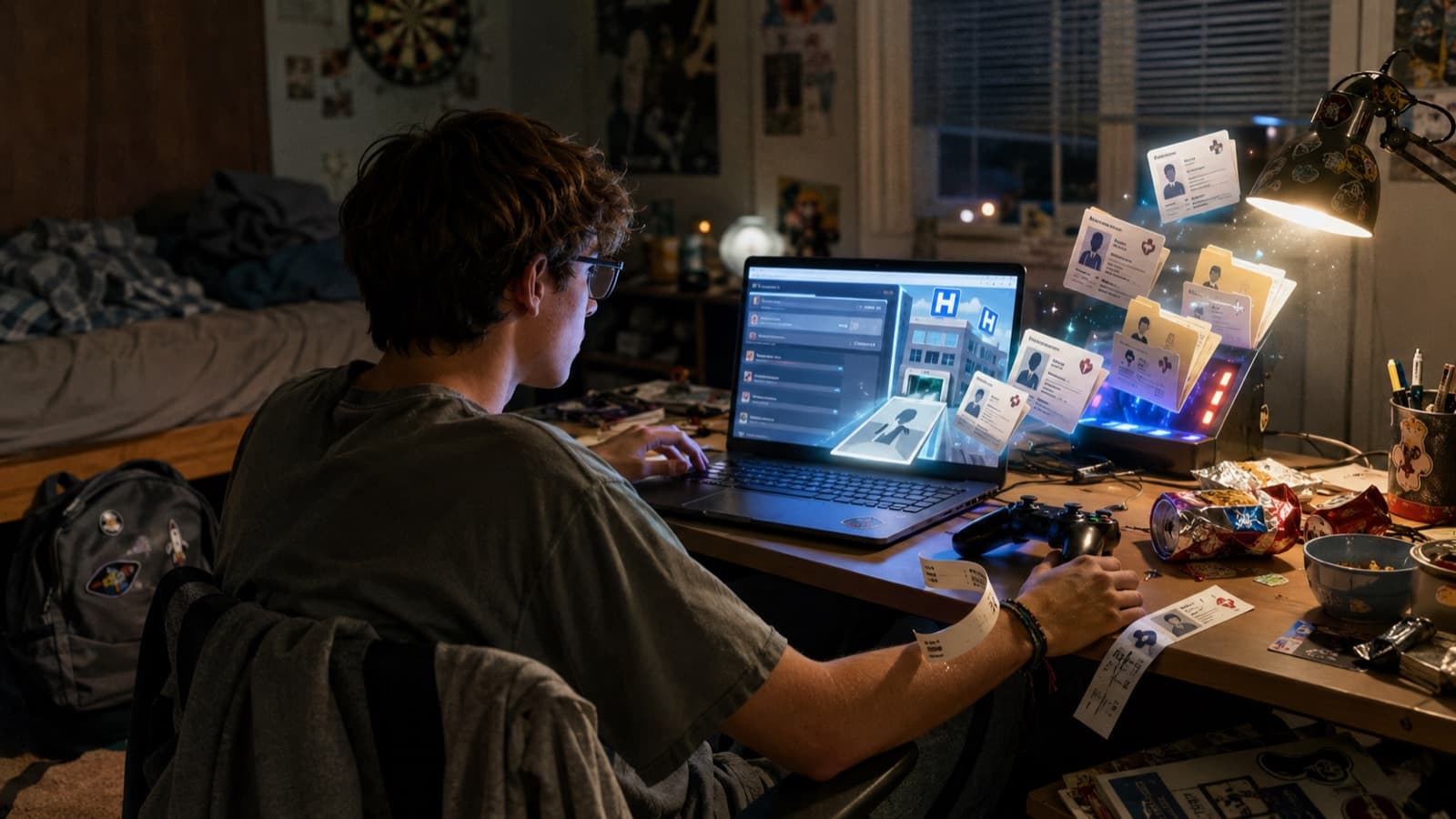
On 23 June 2026, France's anti-cybercrime office arrested five people suspected of belonging to a collective called "Marak." Target: healthcare. Hospitals, clinics, medical companies, about ten facilities hit. The toll: nearly four million patient records stolen. Identities, administrative data, medical follow-up. The five suspects are between 16 and 22 years old.
According to Ofac, the group did not have to break any encryption. It exploited a flaw in the authentication of dematerialised healthcare professional cards, trapping care workers to harvest their credentials. A door left ajar, not a safe forced open.
The investigation had started a year earlier, after the hack of a clinic in the Loire. Nothing exceptional, in fact: two weeks before, the same office had dismantled "Dumpsec," seven arrests and more than 1,500 victim organisations. Kids again.
With every case, the same question comes back. Why are hackers almost always so young?
Why are arrested hackers so young?
Forget the hooded genius lurking in the shadows. The reality is more ordinary, and more unsettling: a teenager in his bedroom. And this is not a French peculiarity. In the UK, the National Crime Agency measured that the average age of suspects in its cyber investigations was around 17, lower than for most other forms of crime. Four mechanisms explain it, and they reinforce one another.
A brain wired for risk. Between 15 and 25, the brain is not finished. The area that weighs consequences and curbs impulses, the prefrontal cortex, matures last. The reward circuit, on the other hand, is already running at full tilt. You underestimate danger, you think you are untouchable, consequences stay an abstraction. Add plenty of free time, with no job and no family to support, and you get the perfect ground to explore relentlessly.
A barrier that has fallen. Hacking no longer requires being a prodigy. Freely available tutorials, mutual-help communities on Discord and Telegram, ready-made tools, cybercrime services rented like a Netflix subscription. The myth of the lone genius is dead. Today you need curiosity, method, and time. Nothing else.
Glory before money. People picture the lure of profit. Among the youngest, the fuel is elsewhere: the challenge, boredom, peer recognition. In these circles, reputation is the only currency that counts. You climb an invisible hierarchy, you aim for the big splash. And that is precisely what undoes them. They boast, they claim credit, they sign their exploits. Discipline comes with age, and most get caught before acquiring it.
Invisible victims. Behind a screen, four million records do not weigh four million lives. They are lines in a file. That distance numbs. It starts with a grey-area curiosity, "am I capable of it?", then you slide, one notch at a time, the justification already prepared: "I'm just showing they were badly protected." You do not feel like a criminal. You feel clever.
Are young hackers really the most dangerous?
Beware the blind spot the headlines forget. If hackers seem so young, it is first because the young are the ones who get caught.
The truly dangerous actors never make the front page. Professional ransomware, state-backed groups: organised, disciplined, patient, and they do not get caught. Marak and Dumpsec are the tip of the iceberg. The loudest, the clumsiest. Not the most threatening. "Hackers are young" describes what arrests reveal, not the reality of the threat. The nuance is crucial when we are talking about the data in our hospitals.
Why does health data leak over and over?
Pointing fingers is not enough, and the good news is that we know exactly what to do. Two projects to run at once: one obvious, one neglected. Let us start with the obvious.
If health data leaks almost every week, it is not because a nurse clicked the wrong link. It is because the applications that host it are sieves. The king of flaws is called IDOR: it is often enough to change a digit in a web address to land on the neighbouring patient's file, for lack of any real access control. A flaw known for twenty years. Still everywhere. In the Marak case the way in came even earlier in the chain, through hijacked authentication of healthcare professional cards, but the principle is the same: access control that does not hold.
The real culprit is not the human, it is the debt. Technical debt of systems cobbled together and never fixed. Governance debt of organisations that never put security at the top of the pile. The answer is as boring as it is urgent: pay down that debt, now. Serious access control, regular offensive testing, audits with teeth. It is obvious. Let us do it, and move on to the real subject.
Handcuff a teenager or recruit a defender?
This is the project no one talks about, and it is the most important. Think for a second. The kid who worked out how to siphon off four million files performs exactly the same act as a security consultant paid six figures for it. Same skill, same curiosity, same persistence. The whole difference comes down to one word: authorisation. A contract, and he becomes a professional everyone is fighting over. Without a contract, he becomes a criminal record.
Yet Europe is desperately looking for cybersecurity specialists. Close to 274,000 posts remain unfilled in the European Union alone, according to ISC2's annual workforce study. We are digging gaping holes in our workforce, and meanwhile we are handcuffing precisely the profile we struggle to recruit. It is absurd. Every arrested teenager is a defender we let slip away.
Why do they tip over to the wrong side? Not out of malice. Out of ease. The illegal path offers everything, right away: the adrenaline, a community that applauds, a scoreboard, zero barrier. The legal path, on the other hand, demands a five-year degree, patience, doors to push open, and months of boredom before the first slightly exciting assignment. At equal talent, we lose the recruitment race on the experience we offer. We offer an obstacle course where the other camp offers a video game.
How do we catch this talent before it is too late?
Let us flip the logic, because France already has the tools, and they work. Bug bounty platforms like YesWeHack, a French flagship, pay researchers to legally find companies' flaws: money, reputation, and no criminal record. Every year ANSSI, our national agency, runs the France Cybersecurity Challenge, a hacking contest open from age 14 that selects the French team for the European Cybersecurity Challenge. Training platforms like Root-Me or Hackropole let you practise as much as you want without breaking anything real. The thrill, the community, the ranking, the glory: everything the teenager is looking for already exists, on the right side of the law.
So the problem is not the absence of alternatives. It is the timing. We arrive too late. We reach out to these young people at twenty, before a judge, when we should have caught them at fourteen, in a school club, before the wrong Discord server did the job. Other countries have understood this. In the UK, the National Crime Agency's Cyber Choices programme redirects young digital offenders toward legal careers rather than toward prison. The maths is simple: converting a talent costs infinitely less than repairing a leak and running a trial. And it turns a threat into a bulwark.
Because a sixteen-year-old who finds a flaw is not Al Capone. He is raw talent waiting to be shown the right door. Our only job is to get there before the other camp does.
Sources
- Arrests of the "Marak" collective (five suspects aged 16 to 22, nearly 4 million records, about ten healthcare facilities): franceinfo, 1 July 2026.
- "Marak" attack method (hijacked authentication of dematerialised healthcare professional cards): DPO Partage, June 2026.
- Dismantling of "Dumpsec" (seven arrests on 9 June 2026, more than 1,500 victim organisations): Le Monde and ZATAZ, June 2026.
- Average age of around 17 among cyber investigation suspects: National Crime Agency, "Pathways into Cyber Crime" report, and The Guardian.
- Redirection programme for young digital offenders: Cyber Choices, National Crime Agency.
- Shortfall of around 274,000 cybersecurity professionals in the European Union: ISC2, Cybersecurity Workforce Study.
- France Cybersecurity Challenge, open from age 14 and selective for the European championship: ANSSI.
- Legal training and bug bounty platforms: YesWeHack, Root-Me and Hackropole (ANSSI).
Frequently asked questions
Why are arrested hackers almost always young?
Because the 15-25 brain is still wired for risk (an immature prefrontal cortex, a reward circuit running at full tilt), because hacking no longer requires being a prodigy (tutorials, communities, ready-made tools), because the fuel is glory and peer recognition more than money, and because the screen makes victims abstract. Above all, the young are the ones who get caught: the truly dangerous actors do not. The UK National Crime Agency has measured an average age of around 17 among the suspects in its cyber investigations.
What is the average age of cybercriminals?
Among arrested offenders, it is very low. In the UK, the National Crime Agency established that the average age of suspects in its cyber investigations was around 17. In France, the alleged members of the Marak and Dumpsec collectives dismantled in June 2026 were aged 16 to 22. One caveat: that age describes the hackers we arrest, not the threat as a whole.
Who are the Marak and Dumpsec collectives?
Two hacking groups dismantled in France in June 2026. "Dumpsec": seven arrests on 9 June, more than 1,500 organisations hit. "Marak": five arrests announced in late June, nearly four million patient records stolen from about ten healthcare facilities. According to Ofac, France's anti-cybercrime office, Marak exploited a flaw in the authentication of dematerialised healthcare professional cards.
How does health data leak?
Often through an application flaw known for twenty years, IDOR: changing a digit in a web address is enough to display the neighbouring patient's file, for lack of access control. In the Marak case, the way in was hijacked authentication of professional cards. In both cases the real culprit is not an isolated human error but technical and governance debt.
Are young hackers the most dangerous?
No. They are the most visible, because they boast and get caught. The genuinely threatening actors, professional ransomware crews and state-backed groups, are organised, disciplined, patient, and they do not make the headlines. "Hackers are young" describes what arrests reveal, not the reality of the threat.
What should we do with young hacking talent?
Catch them early (from age 14) and steer them toward the legal paths that already exist in France: bug bounty (YesWeHack), ANSSI's France Cybersecurity Challenge, training platforms (Root-Me, Hackropole). The UK already redirects its young digital offenders toward legal careers through the Cyber Choices programme. Converting a talent costs far less than repairing a leak and running a trial.
How many cybersecurity jobs remain unfilled in Europe?
Close to 274,000 in the European Union alone, according to ISC2's annual workforce study. That is the paradox: we are desperately short of defenders and, at the same time, we are prosecuting young profiles who hold exactly those skills.

The author
Christophe MazzolaI write about cybersecurity as it's actually lived: governance, the human factor, and everything audit reports don't dare tell the board. Author of « Être en cybersécurité ».
Être en cybersécurité
A cyber roadmap in plain language, for everyone, not just the experts.