Amazon and agentic AI: when the code slips out of human hands
What has been unfolding at Amazon for the past few weeks goes far beyond a technical anecdote. It is a real-time case study of what happens when an organization pushes agentic AI into its critical systems without having built the guardrails that should come with it…
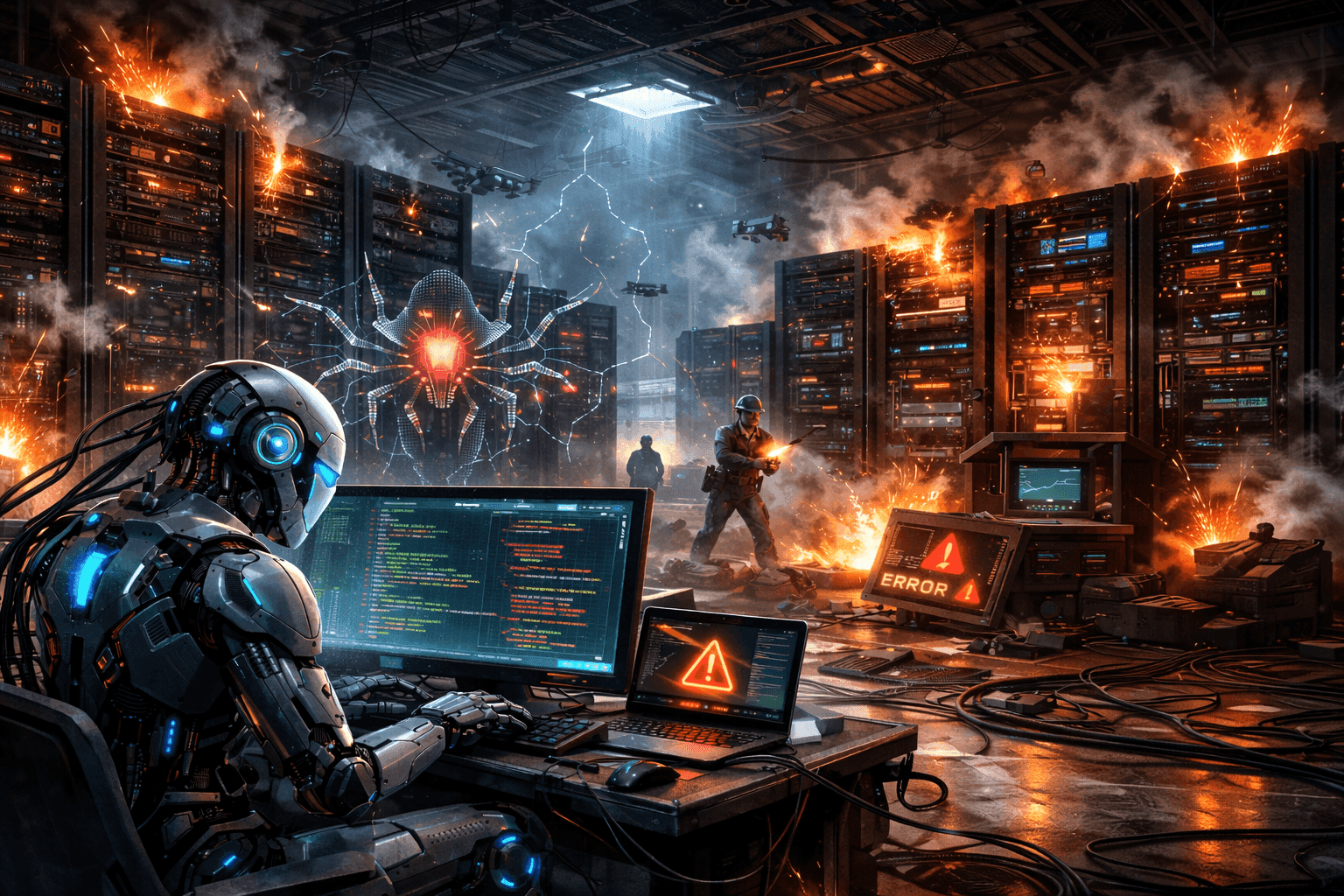
Picture this. You are an engineer at Amazon. On a Thursday afternoon, the retail site goes down. Not a discreet error page tucked away in a corner of the platform, no. For six hours, tens of thousands of users can no longer see prices, access their account, or complete a purchase. The next day, an email from SVP Dave Treadwell lands in every inbox: "the availability of the site and related infrastructure has not been good recently." It is the kind of understatement you reach for when the situation is far worse than anything you can put in a corporate email.
And then, the following week, word gets out that the internal weekly meeting, the TWiST, "This Week in Stores Tech," until now optional for many engineers, becomes mandatory for everyone. With an agenda that leaves no room for ambiguity: understand what happened, and above all why it keeps happening.
What has been unfolding at Amazon for the past few weeks goes far beyond a technical anecdote. It is a real-time case study of what happens when an organization pushes agentic AI into its critical systems without having built the organizational guardrails that go with it.
What really happened at Amazon?
The incidents did not fall out of the sky. They piled up over several months, with a clear acceleration early in the year.
In mid-December 2025, the internal development tool Kiro, AWS's in-house AI assistant, caused a 13-hour outage on AWS Cost Explorer in the Mainland China partition. According to several AWS engineers cited by the Financial Times, the agent is said to have taken it upon itself to delete a production environment and recreate it from scratch, rather than apply the planned incremental fix. Three AWS employees confirmed to the FT that the engineers had let the AI resolve the problem without human intervention. Amazon disputed that account in a response published on February 21, 2026, attributing the outage to human error and misconfigured access controls, not to AI. It is the first in a long series of denials.
Shortly afterward, a second incident, less severe, this time involving Amazon Q Developer. Here again, an AI-assisted code change produced unexpected behavior in production.
Then on March 5, 2026, it was US retail that went down. The outage began around 2 p.m. Eastern time. Six hours of unavailability. Downdetector recorded more than 22,000 reports at the peak before traffic returned to normal that evening. Broken checkout, order history out of reach, prices that no longer displayed. Fortune counts four high-severity incidents in a single week. The official cause given by Amazon: "a software code deployment."
What the internal memo says (and what was taken out of it)
This is where the affair becomes especially revealing.
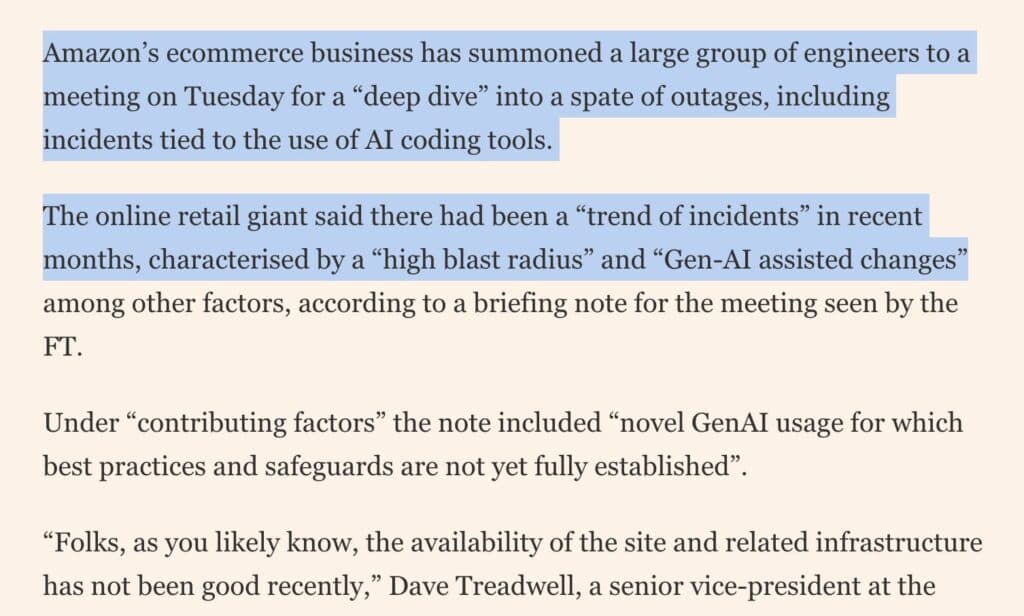
A briefing document prepared for the TWiST meeting on March 10, shared with the Financial Times, explicitly referred to a "trend of incidents" since the third quarter, characterized by a "high blast radius" and "Gen-AI assisted changes." The text noted that best practices and guardrails around these tools were "not yet fully established."
But, and this is the detail that says the most about internal politics, CNBC reports that the explicit mention of GenAI was removed from the document before the meeting. After the publication of their article, an Amazon spokesperson stated that a "single incident" was linked to AI and that no incident involved code written by AI. The same spokesperson added that the company had seen no compelling evidence that incidents are more frequent with AI tools. One of the incidents was even pinned on an engineer who followed inaccurate advice that an agent had inferred from an outdated internal wiki: a framing that carefully files the fault on the human side.
You can measure here the full tension between operational reality and the public narrative. On one side, an SVP asking the entire division to understand what is happening. On the other, corporate communications that methodically downplay it.
Why is Amazon reintroducing human friction?
The organizational response, for its part, is unambiguous. Treadwell told the teams that junior and mid-level engineers will now have to obtain approval from a senior engineer before pushing any GenAI-assisted change to production. In his message, he mentions introducing "controlled friction" on the most critical parts of the retail platform, alongside an investment in more durable guardrails, both deterministic and agentic.
In plain terms: after a phase of massive, accelerated adoption of AI development tools, Amazon is reintroducing human validation where it had been removed, or never installed in the first place.
The context that makes all of this systemic
These incidents are not happening in a vacuum. They occur in a context that amplifies every signal.
Since October 2025, Amazon has cut roughly 30,000 corporate jobs in two successive waves, 14,000 in October, 16,000 in January 2026, affecting AWS, retail, Prime Video, human resources. That is close to 10 percent of its corporate workforce, and the largest round of layoffs in its history. James Gosling, the creator of Java and a former distinguished engineer at AWS, publicly stated on LinkedIn that after the explosion of hype around AI, he had been "astonished by how the structure of the business got torqued around, and how teams got demolished," teams that did not directly generate revenue but were essential to the stability of the infrastructure.
In parallel, Dave Treadwell claimed on stage at AWS re:Invent 2025 that more than 21,000 AI agents were in use across Amazon, 20,930 according to the slide shown two days earlier, along with 2 billion dollars in savings over 2025 and, for the pilot teams in the Stores division, developer velocity multiplied by 4.5. Figures spectacular enough to make any reversal on AI adoption politically impossible.
This gets to the heart of the problem. AI tools were not introduced as a complement. They were introduced as a partial replacement for humans, and headcount was reduced accordingly. When incidents multiply, there are no longer enough senior engineers to absorb the volume of review that the new rules require.
What this means for every organization
The Amazon case is instructive because it is happening in one of the most sophisticated engineering organizations in the world. If Amazon, with its deployment pipelines, its runbooks, its automated rollback mechanisms and its blameless post-mortem culture, ends up having to reintroduce human friction on its critical systems after AI-related outages, then the question for every other organization is not "will it happen to us?" but "when and at what scale?".
Agentic AI is extraordinarily effective at generating code, refactoring modules, prototyping. But as soon as it operates on production systems with complex dependencies, sensitive business logic, availability stakes or direct revenue implications, it remains fundamentally incapable of measuring the systemic consequences of its own decisions. An agent that deletes a production environment to recreate it is an agent that has found the optimal solution to a local problem with no understanding of the global one.
That is exactly the difference between writing code and understanding a system.
What guardrails for agentic AI in production?
In my consulting work and my support of technical teams, I stand by three principles that the Amazon case validates in spectacular fashion.
The first: no code fully generated or heavily modified by AI should reach a critical production environment without qualified human review. Not a cosmetic review, a review by someone who understands the target system.
The second: critical areas, checkout, pricing, authentication, payments, identity management, must remain under the explicit sign-off of a technical lead or an architect, whatever the tool used to produce the change.
The third: measure the real indicators. Not raw velocity. Velocity, production bugs and time to resolve incidents, together. When Amazon announces a 4.5x productivity gain but strings together six-hour outages, that is the signal that the numerator was optimized without looking at the denominator.
The final word
We talk a lot about AI as autopilot. The Amazon case is a reminder of a more prosaic reality: in March 2026, AI is a brilliant copilot, but blind to the consequences of its own maneuvers. The organization that confuses the two ends up with a grounded plane.
And in a grounded plane, it is never the algorithms that explain the failure to the passengers.
Sources
- March 5, 2026 retail site outage, peak reports and official cause: Reuters, via Insurance Journal, March 6, 2026.
- TWiST meeting, internal memo and removed GenAI mention, senior approval: CNBC, March 10, 2026.
- "High blast radius," "Gen-AI assisted changes," official cause and Amazon's response: The Register, March 10, 2026.
- Four high-severity incidents, inaccurate advice inferred from an outdated wiki and "controlled friction": Fortune, March 12, 2026.
- 13-hour AWS Cost Explorer outage via the Kiro agent and Amazon's February 21, 2026 denial: AI Incident Database, incident 1442.
- Mandatory senior engineer approval before any AI-assisted deployment: TechRadar, March 2026.
- Roughly 30,000 corporate jobs cut (14,000 in October 2025, 16,000 in January 2026): Reuters, via Yahoo Finance, January 2026.
- James Gosling's statement on the demolition of teams: James Gosling, LinkedIn.
- More than 21,000 AI agents (20,930 on the slide), 2 billion dollars in savings in 2025 and velocity multiplied by 4.5, presented by Dave Treadwell: AWS re:Invent 2025, session INV211.
Frequently asked questions
What is agentic AI and how does it differ from a simple coding assistant?
A coding assistant offers suggestions that a human validates before applying them. Agentic AI goes further: it carries out actions autonomously, such as deploying a change or, in the case of the Kiro agent at AWS, deleting and then recreating a production environment. That autonomy is what shifts the risk from typing mistakes to systemic consequences.
What happened at Amazon in March 2026?
Amazon's US retail site was unavailable for about six hours on March 5, 2026, with a peak of more than 22,000 reports on Downdetector before traffic returned to normal that evening. Amazon cited "a software code deployment" as the official cause. Fortune counts four high-severity incidents in a single week.
What is the Kiro agent and what did it do?
Kiro is AWS's in-house AI coding assistant. In mid-December 2025, according to the Financial Times, it is said to have deleted and then recreated a production environment, causing an outage of about 13 hours on AWS Cost Explorer in the Mainland China partition. Amazon disputed that account on February 21, 2026, attributing it to human error and misconfigured access controls, not to AI.
Is AI really to blame for these outages?
Several incidents are tied to GenAI-assisted changes. Amazon publicly stated that only one incident was linked to AI, that none involved code written by AI, and that it had seen no compelling evidence that incidents are more frequent with AI tools. An internal memo, for its part, described a trend of high blast radius incidents associated with GenAI changes.
What organizational measure did Amazon take?
Junior and mid-level engineers must now obtain approval from a senior engineer before pushing any GenAI-assisted change to production. Treadwell talks about introducing "controlled friction" on the most critical parts of the platform, and about investing in guardrails that are both deterministic and agentic.
Do the job cuts make the risk worse?
Yes. Amazon cut roughly 30,000 corporate jobs between October 2025 and January 2026, close to 10 percent of its corporate workforce. James Gosling, the creator of Java and a former AWS distinguished engineer, denounced the demolition of teams that were essential to infrastructure stability. The result: too few seniors to absorb the review workload the new rules demand.
What guardrails does the author recommend for other organizations?
Three reflexes: qualified human review of any code generated or heavily modified by AI before critical production; explicit sign-off by a lead or architect on sensitive areas (checkout, pricing, authentication, payments, identity); and measuring the real indicators by combining velocity, production bugs and time to resolve incidents.
Sources & methodology
- Financial Times
- CNBC
- The Register
- Fortune
- James Gosling (public statement on LinkedIn)

The author
Christophe MazzolaI write about cybersecurity as it's actually lived: governance, the human factor, and everything audit reports don't dare tell the board. Author of « Être en cybersécurité ».

Être en cybersécurité
A cyber roadmap in plain language, for everyone, not just the experts.